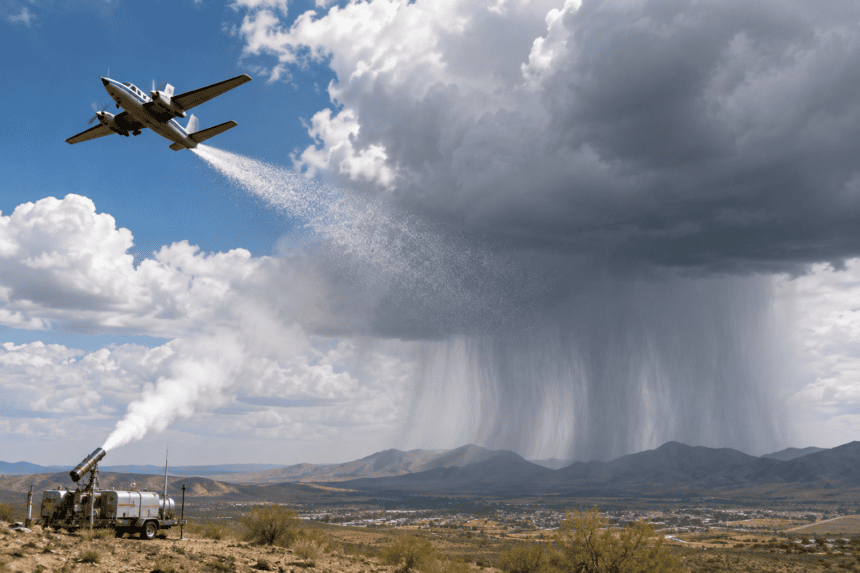
Private companies are aggressively marketing cloud seeding as a silver bullet for drought-stricken regions, promising to manufacture rainfall on demand. From the American West to the Middle East, these firms claim their technology—dispersing silver iodide or salt flares into clouds via aircraft or drones—can reliably boost precipitation by 10% to 20%.
But the science tells a murkier story. While the process of cloud seeding has existed since the 1940s, researchers remain divided on whether it creates new rain or simply relocates it.
“We are essentially nudging a cloud that is already primed to drop water,” says Dr. Sarah Jenkins, an atmospheric scientist who has spent a decade studying weather modification. “The industry sells a promise of control, but the atmosphere doesn’t work like a faucet you can just turn on.”
Despite the skepticism from academia, the market is booming. Governments in the UAE, China, and several U.S. states are pouring millions into contracts with private weather-modification firms. These companies often present data showing increased snowfall or rainfall in target areas, yet critics point out that these figures rarely account for natural weather variability. It is notoriously difficult to prove that a storm would have been drier without human intervention.
The legal and ethical implications are mounting alongside the corporate interest. If a company “steals” moisture from the clouds before they reach a neighboring province or country, who owns that rain? Hydropolitics are already tense in arid zones, and the prospect of commercialized weather modification threatens to turn clouds into a commodity.
“There is a massive gap between what these companies promise in a boardroom and what they can deliver in a complex climate system,” says Marcus Thorne, a policy analyst tracking environmental tech. “When you commodify the weather, you’re selling a product that nature can refuse to provide at any moment.”
As these firms continue to pitch their services to desperate municipalities, the burden of proof rests on them. Until they can produce peer-reviewed, reproducible evidence that their methods work consistently, their “rain-making” will remain more of a high-stakes gamble than a climate solution.