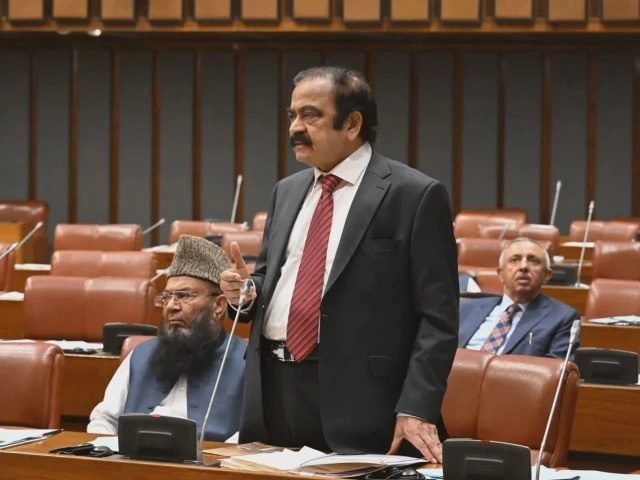
ISLAMABAD: Adviser to the Prime Minister on Political and Public Affairs Rana Sanaullah Khan told the Senate on Tuesday that the Supreme Court will determine on September 16 whether its August 18 order concerning Pakistan Tehreek-e-Insaf (PTI) founder Imran Khan’s medical examination was implemented and to what extent.
Responding to questions from Senator Ali Zafar and Senate Opposition Leader Raja Nasir Abbas, Sanaullah said the court would assess whether there had been any shortcomings in the implementation of its order.
He assured the Senate that if the Supreme Court identified any deficiency and issued further directions, the government would implement them.
The statement comes amid a dispute over the implementation of the court’s August 18 order, which directed authorities to transfer Imran Khan to Shifa International Hospital for medical treatment and arrange weekly meetings between him and his family.
Imran was instead taken to the Pakistan Institute of Medical Sciences (PIMS) for a medical examination before being returned to Adiala Jail. PTI subsequently filed a contempt petition in the Supreme Court, alleging that the court’s directions had not been followed.
Sanaullah said neither the government nor the opposition should assume the role of the court and issue their own judgments on whether a judicial order had been complied with.
He said the government, state institutions and courts were bound by the Constitution and law, which also provided legal mechanisms for reviewing disputed implementation of court orders.
According to Sanaullah, the government had made a sincere effort to comply with the Supreme Court’s directions. He said the purpose of taking Imran Khan to hospital was to ensure that he received a medical examination.
He explained that the original plan was changed because authorities had security concerns over the situation that could develop at the intended hospital. Imran was therefore taken to a government health facility, where Sanaullah said he underwent a comprehensive examination by qualified doctors.
The adviser maintained that the government had no intention of compromising Imran Khan’s health and said no negligence had occurred in the past or would be allowed in future.
He also criticised what he described as political messaging following meetings with Imran Khan, saying statements emerging from such meetings were subsequently repeated at press conferences and circulated on social media, including from abroad.
A report submitted to the Supreme Court by the Adiala Jail superintendent last week included details of Imran’s medical consultations and examinations. The report highlighted concerns regarding his blood pressure and recommended greater interaction with family members to help reduce anxiety.
According to the report, a PIMS cardiologist examined Imran on August 1 and recorded his blood pressure at 140/100 mmHg. The doctor recommended measures to reduce mental stress, including more frequent family meetings and access to reading material.
A four-member medical board that examined him on August 10 recorded his blood pressure at 140/80 mmHg and recommended walking, relaxation and more frequent interaction with close family members and his spouse.
The report said Imran had undergone at least 39 medical examinations since his imprisonment, while jail medical officers checked him three times a day. It also stated that his electrocardiogram was normal and that his eyesight had improved to nearly normal following treatment.
PTI, however, questioned the authenticity and completeness of the medical records and demanded that Imran be examined by his personal doctors, Dr Asim Yusuf and Dr Faisal Sultan, as well as an independent medical board.
The government has rejected allegations that Imran is being denied adequate medical care, maintaining that he is receiving treatment from specialists in accordance with the law and relevant court orders.
The Supreme Court subsequently directed the government to arrange weekly meetings between Imran and his family, allow his personal physician Dr Faisal Sultan access to him and establish a medical board comprising an eye specialist, general physician and cardiologist along with Dr Sultan.
The court also directed Imran’s family and lawyers not to share his medical reports with the media and ordered that the documents remain confidential.
PTI Chairman Barrister Gohar Khan said the Supreme Court’s order should be implemented in letter and spirit.
Speaking to reporters, Gohar said the issue should not be turned into a political dispute or a war of words.
He maintained that the order clearly directed that Imran Khan be shifted to Shifa International Hospital and that a medical board be constituted to conduct his examination and treatment.
Gohar described the matter as straightforward and said the decision to divert Imran’s transfer was inappropriate. He added that PTI also had security concerns and did not want security protocols violated.
According to Gohar, the government had never informed the party beforehand that security concerns would prevent Imran’s transfer to Shifa.