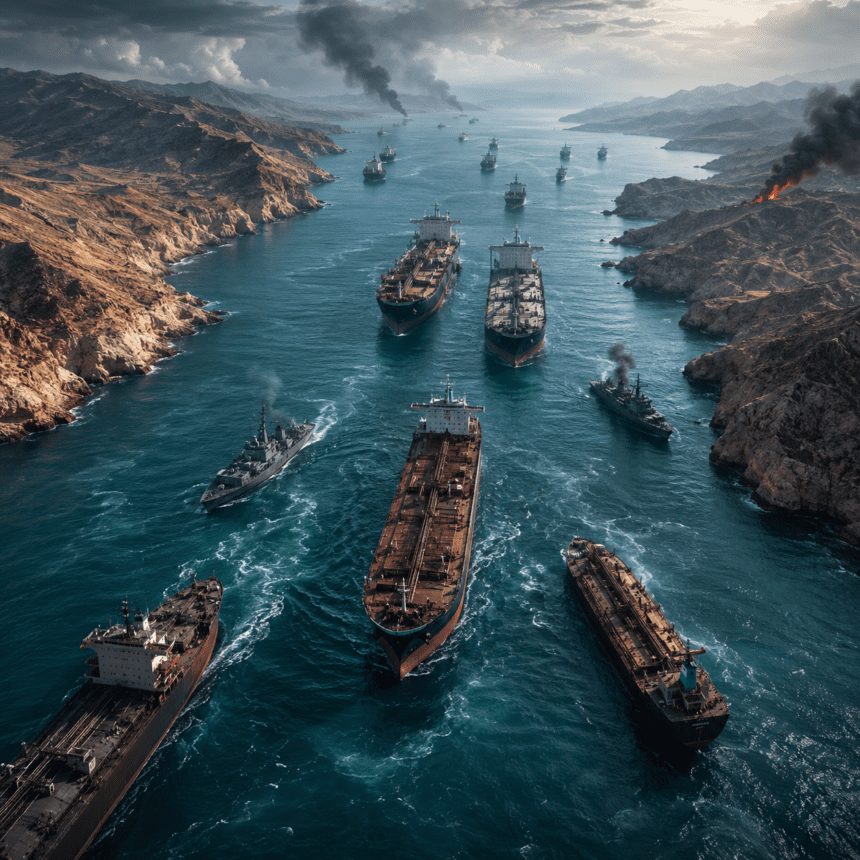
The Strait of Hormuz—the world’s most critical maritime oil artery—remains effectively closed to commercial traffic today. Following a series of sharp naval skirmishes late yesterday, shipping companies have ordered vessels to divert, leaving the global energy market bracing for a massive supply shock.
At least three tankers were forced to alter course after reports of direct fire between regional naval units near the Omani coast. Insurance premiums for passage through the strait have spiked by 400% in under twelve hours. Lloyd’s of London has already categorized the waterway as a “high-risk zone,” effectively drying up the appetite for any captain willing to risk a transit.
The closure hits hard. Roughly 20% of the world’s total petroleum consumption passes through this narrow bottleneck daily. If the tankers don’t move, the price at the pump for the average consumer won’t just rise—it will spike within days.
Regional military officials remain tight-lipped, but radio chatter intercepted by maritime monitoring groups suggests the skirmish wasn’t a random flare-up. It was a calibrated display of force. One senior analyst at a Dubai-based maritime security firm noted that the speed of the transit halts indicates this wasn’t just a skirmish; it was a blockade in all but name.
“The market is reacting to the uncertainty, not just the physical blockade,” said Sarah Jenkins, an energy commodities strategist. “Companies don’t care who fired the first shot. They care that their cargo is now sitting in a war zone, and they aren’t moving until they get a green light from naval escorts that currently don’t exist.”
Global powers are scrambling. The U.S. Fifth Fleet has moved assets toward the mouth of the strait, though officials have refused to confirm if they intend to provide escort services for commercial ships. Without a clear guarantee of safe passage, the major shipping lines—including Maersk and MSC—have officially suspended all transit until further notice.
Iran’s state media has characterized the naval activity as a “defensive drill” gone wrong, while regional neighbors accuse Tehran of using the maritime theater to leverage diplomatic concessions. Regardless of the motive, the physical reality remains unchanged: the ships are sitting idle, the oil is not moving, and the world is holding its breath.