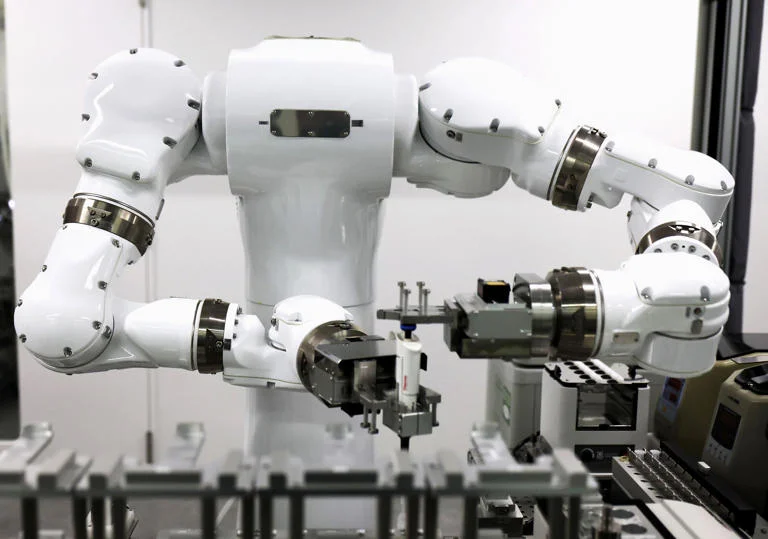
The lights are on at the University of Tokyo’s newest chemistry lab, but the lab coats are gone. In a move that signals a shift for experimental science, the university has officially opened a facility where robots handle the entire research cycle from mixing chemicals to analyzing results without a single human in the room.
This isn’t just a room with a few automated arms. It’s a closed-loop system designed to hunt for new materials for batteries and semiconductors at speeds that make traditional methods look like they’re standing still. The AI designs the experiment, the robots execute it, and the data feeds right back into the AI to decide what happens next.
“The goal is to remove the bottleneck of human physical labor,” a researcher involved in the project’s pilot phase said. “A human can do maybe ten experiments a day. This system won’t stop at ten, and it doesn’t need to go home at 5:00 PM.
The stakes are high. Japan is currently locked in a global race to find more efficient materials for the next generation of electric vehicle batteries. By cutting humans out of the “pipette-and-wait” cycle, the university expects to compress years of trial-and-error into a few weeks of non-stop robotic iteration.
It’s a response to a looming crisis, too. Japan’s shrinking workforce means there are fewer young scientists entering the field every year. Automating the grunt work isn’t just about speed; it’s about survival in a country where human talent is becoming a scarce resource.
Critics often worry that “robot-run” means “job-lost,” but the university’s lead engineers argue the opposite. They say the move frees up researchers to actually think, rather than spending eight hours a day performing repetitive liquid handling.
The robots don’t get bored, they don’t make clerical errors, and they don’t suffer from “Friday afternoon” fatigue that can ruin a data set. The lab is currently focused on thin-film materials, but the team plans to scale the technology to other branches of chemistry soon.
If it works, the image of the lone scientist hunched over a workbench might soon be a relic of the past. The lab is running right now. It’ll be running tomorrow morning. And it won’t need a coffee break to get through the night.
The lights are on at the University of Tokyo’s newest chemistry lab, but the lab coats are gone. In a move that signals a shift for experimental science, the university has officially opened a facility where robots handle the entire research cycle from mixing chemicals to analyzing results without a single human in the room.
This isn’t just a room with a few automated arms. It’s a closed-loop system designed to hunt for new materials for batteries and semiconductors at speeds that make traditional methods look like they’re standing still. The AI designs the experiment, the robots execute it, and the data feeds right back into the AI to decide what happens next.
“The goal is to remove the bottleneck of human physical labor,” a researcher involved in the project’s pilot phase said. “A human can do maybe ten experiments a day. This system won’t stop at ten, and it doesn’t need to go home at 5:00 PM.” The stakes are high. Japan is currently locked in a global race to find more efficient materials for the next generation of electric vehicle batteries.
By cutting humans out of the “pipette-and-wait” cycle, the university expects to compress years of trial-and-error into a few weeks of non-stop robotic iteration.
It’s a response to a looming crisis, too. Japan’s shrinking workforce means there are fewer young scientists entering the field every year. Automating the grunt work isn’t just about speed; it’s about survival in a country where human talent is becoming a scarce resource. Critics often worry that “robot-run” means “job-lost,” but the university’s lead engineers argue the opposite.
They say the move frees up researchers to actually think, rather than spending eight hours a day performing repetitive liquid handling. The robots don’t get bored, they don’t make clerical errors, and they don’t suffer from “Friday afternoon” fatigue that can ruin a data set.
The lab is currently focused on thin-film materials, but the team plans to scale the technology to other branches of chemistry soon. If it works, the image of the lone scientist hunched over a workbench might soon be a relic of the past. The lab is running right now. It’ll be running tomorrow morning. And it won’t need a coffee break to get through the night.