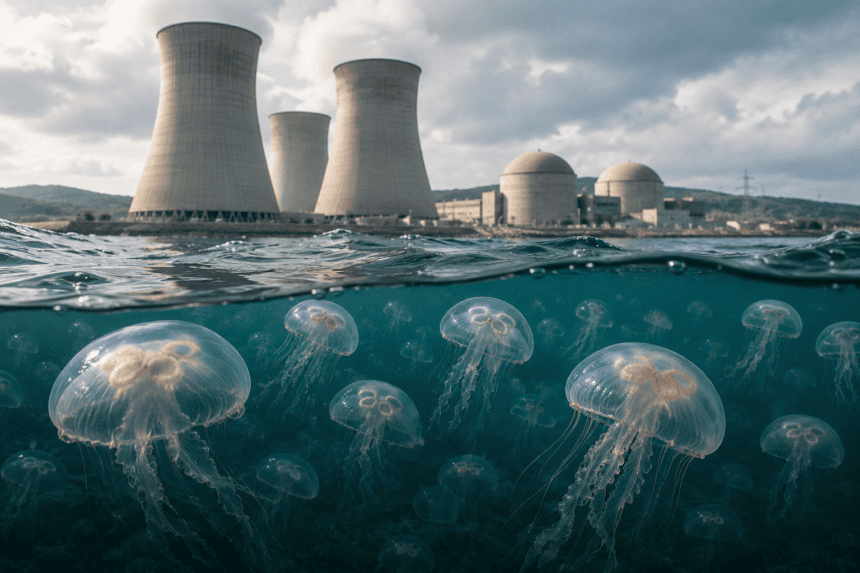
FLAMANVILLE, France — A massive swarm of jellyfish has forced operators to throttle production at the Flamanville nuclear power plant, a recurring technical headache that highlights the vulnerability of coastal infrastructure to shifting marine ecosystems.
Electricité de France (EDF) confirmed that the intake filters at the site—located on the English Channel—became overwhelmed by the gelatinous mass on Tuesday. Operators were forced to reduce the power output of the plant’s reactors to prevent the cooling systems from clogging.
This isn’t a mechanical failure in the traditional sense. It’s biology interfering with physics. The plant relies on vast quantities of seawater to cool its reactors. When jellyfish are pulled into the intake pipes in massive numbers, they act like a biological dam, forcing engineers to dial back operations to protect the internal cooling mechanisms.
While the plant’s safety protocols functioned exactly as designed, the incident serves as a stark reminder of how sensitive nuclear facilities are to environmental changes. Rising ocean temperatures have led to an increase in jellyfish blooms globally, creating more frequent disruptions for coastal plants from Japan to the Middle East.
EDF engineers have spent years refining the screening systems at Flamanville, but the sheer volume of this week’s bloom proved too much for the existing filtration infrastructure to handle at full capacity. The utility company has not yet provided a timeline for when the reactors will return to 100% output, noting that the situation remains fluid until the swarm passes.
Local environmental experts point to the warming waters of the English Channel as a primary driver for these localized population explosions. As the climate shifts, the frequency of these “biological outages” is moving from a rare anomaly to a predictable operational challenge for coastal energy providers.
For now, the plant continues to operate at a reduced capacity. The grid remains stable, but the incident underscores a persistent reality: even the most advanced nuclear technology remains at the mercy of the sea.