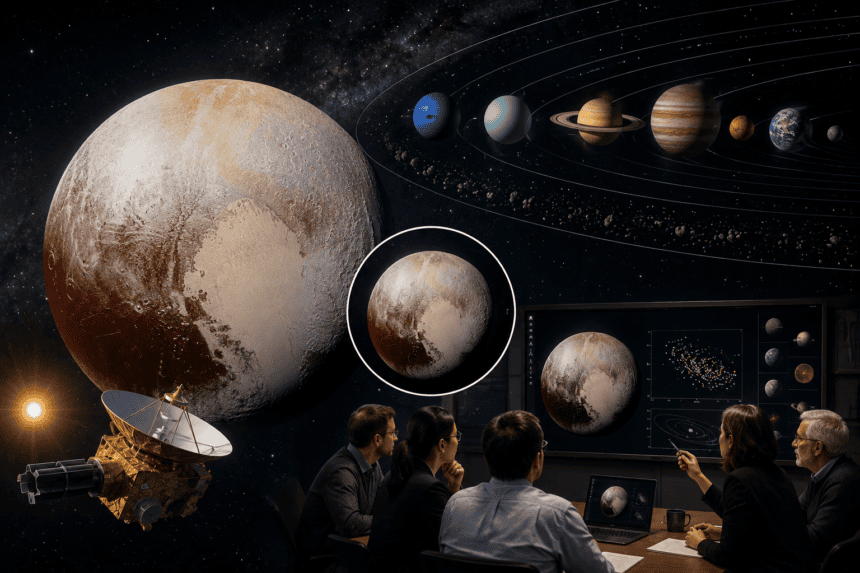
The definition of a planet is under fire again. Nearly two decades after the International Astronomical Union (IAU) famously demoted Pluto to “dwarf planet” status, a vocal contingent of planetary scientists is pushing to reclaim its title.
The 2006 decision in Prague turned on a specific requirement: a planet must “clear its neighborhood” of other debris in its orbit. Pluto, sharing its path with thousands of Kuiper Belt objects, failed that test. Critics now argue that criteria is not only outdated but geologically illiterate.
“The current definition is a mess,” said Dr. Philip Metzger, a planetary scientist at the University of Central Florida. He led a recent study arguing that the IAU’s criteria ignore the physical characteristics that actually define a world.
For these researchers, the focus should shift from where an object is to what it is. Pluto has a complex atmosphere, layered terrain, organic compounds, and evidence of ancient lakes. It possesses a heart-shaped nitrogen glacier that shifts and moves. Under the current “clearing the neighborhood” rule, even Earth would fail if it were pushed into a different orbit, as our planet’s gravity isn’t strong enough to clear asteroids at such a distance from the sun.
The debate isn’t just about semantics. It’s about how we classify thousands of new worlds discovered in the outer solar system. If we prioritize geology over orbital mechanics, the number of planets in our solar system could jump from eight to over 100.
Critics of the reclassification argue that expanding the list would confuse the public and complicate school textbooks. They maintain that the 2006 vote, while contentious, provided a necessary framework to keep the planetary roster manageable.
Yet, for those working on the ground, the “dwarf” label feels like a slight against the science of planetary evolution. They see a world that is active, dynamic, and anything but a mere rock in the dark.
Whether the IAU will revisit the vote remains uncertain. For now, the debate forces a fundamental question: do we define a planet by its lonely path through space, or by the complex life of the world itself?