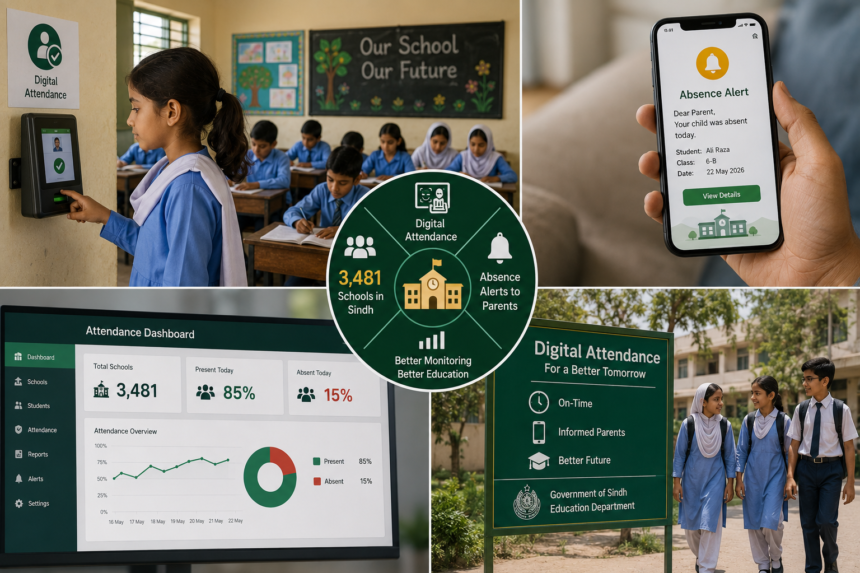
Sindh’s education department has officially rolled out a digital attendance system across 3,481 government schools. The move marks a shift away from manual registers, linking student attendance directly to a centralized database that triggers real-time alerts to parents via SMS.
The initiative targets the province’s chronic issue of student dropout rates and “ghost” enrollments. By digitizing the daily check-in process, the Sindh Education and Literacy Department aims to force accountability on both the teaching staff and the students.
Parents will now receive automated notifications if their child is marked absent. This instantaneous feedback loop is designed to prevent long-term absenteeism before it leads to students dropping out entirely. For years, school administrators in remote districts have struggled with verifying daily attendance, leaving room for data manipulation. This system closes that gap.
The implementation follows a pilot phase conducted in select districts earlier this year. Officials confirmed that biometric devices and tablet-based software have been distributed to the identified schools. Teachers are required to record attendance within the first hour of the school day. Failure to sync the data by the daily cutoff time will now flag the school’s administration for an immediate audit.
Critics of the rollout point to the province’s uneven infrastructure. In several rural areas, consistent power supply and stable internet connectivity remain major hurdles. Without a reliable power source to charge the tablets or a network to transmit the data, the system risks becoming another bureaucratic layer that fails in the field.
“The technology is a tool, not a solution,” said an education policy researcher based in Karachi. “If the underlying issues of teacher shortages and poor school facilities aren’t addressed, sending a text message to a parent doesn’t change the quality of the classroom.”
Despite these concerns, the provincial government is pushing forward with plans to expand the digital network to all remaining public schools by the end of the next fiscal year. For now, the success of the program rests on whether the department can maintain the hardware in districts where even basic infrastructure often breaks down.
The education department has yet to announce if teachers who fail to log attendance will face salary deductions, though officials suggest that the digital trail will eventually be used to determine performance-based incentives.