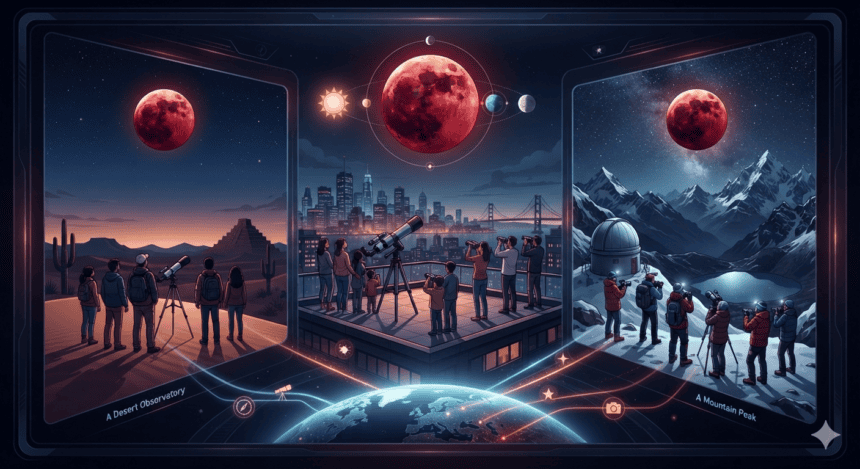
Stargazers across the globe turned their eyes upward Tuesday as a total lunar eclipse transformed the full moon into a deep, rust-colored orb. The celestial event—a “Blood Moon”—occurred as the Earth passed directly between the sun and the moon, casting its shadow across the lunar surface.
For observers in North America, the show began in the early hours. West Coast viewers caught the peak just before dawn, while those in the East watched the moon slip into shadow during the pre-dawn darkness. The phenomenon lasted roughly 85 minutes, during which the moon didn’t vanish entirely; instead, it took on a copper glow.
This color shift isn’t a trick of the light. It’s the result of sunlight filtering through Earth’s atmosphere. As our planet blocks direct solar rays, it scatters blue light, allowing only longer, redder wavelengths to reach the moon’s surface. Essentially, the moon is illuminated by every sunrise and sunset happening on Earth at that exact moment.
“It’s a reminder of our place in the orbital dance,” said Sarah Jenkins, an astrophysicist who monitored the event from a public viewing site in Arizona. “You’re looking at the Earth’s shadow projected onto another world in real-time.”
Unlike solar eclipses, which require specialized glasses to view safely, the lunar eclipse was visible to the naked eye. No equipment was needed, though many amateur astronomers used binoculars or telescopes to catch detail in the lunar craters as they darkened.
The event drew crowds to parks and dark-sky preserves from the Americas to parts of Asia and Australia. In major cities, light pollution proved a hurdle for some, but the moon’s brightness—even during the eclipse—remained distinct against the night sky.
This was the final total lunar eclipse visible until March 2025. The next three years will feature partial eclipses, but the distinct crimson light that captivated observers Tuesday won’t return to the full scale until that window opens again in the mid-decade.
For those who missed the timing, the moon has already returned to its standard white glow, marking the end of a rare alignment that brought thousands of people outside to share a brief, silent look at the mechanics of the solar system.