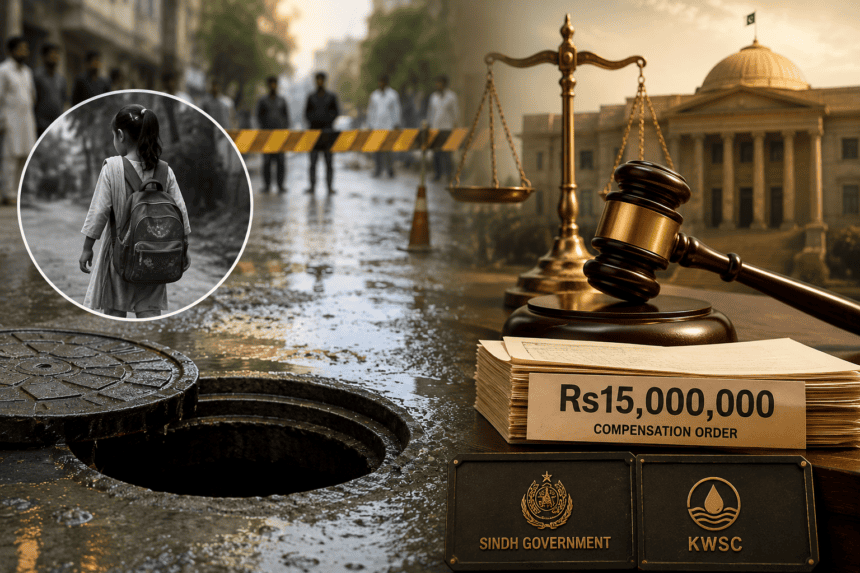
The Sindh High Court has ordered the provincial government and the Karachi Water and Sewerage Corporation (KWSC) to pay Rs15 million in compensation to the family of a young girl who died after falling into an open manhole in Karachi.
The court’s decision settles a long-standing legal battle, holding the municipal authorities directly accountable for the fatal negligence that claimed the child’s life. Justice Zulfiqar Ahmed Khan, presiding over the bench, rejected the defense’s attempt to shift blame, labeling the incident a systemic failure of civic maintenance.
The tragedy, which sparked widespread public outrage, highlighted the lethal state of Karachi’s crumbling infrastructure. For residents in the area, the open manhole was a known danger—one that officials had ignored despite repeated complaints. The court noted that the KWSC and the Sindh government failed to fulfill their primary duty: ensuring the safety of public spaces.
The Rs15 million payout is to be shared equally between the provincial government and the water utility. The court directed that the funds be deposited as a fixed-term investment, with the monthly interest accruing to the victim’s parents.
Beyond the financial penalty, the ruling serves as a stark warning to city administrators. By imposing a heavy fine, the court is signaling an end to the culture of impunity that has long allowed municipal departments to escape consequences for infrastructure-related deaths.
Legal observers view the verdict as a rare but necessary intervention. While money cannot replace a child, the court’s decision to hold the state financially liable forces the government to confront the human cost of its administrative paralysis.
Whether this ruling prompts a city-wide safety audit remains the central question for Karachi’s millions. For now, the legal mandate stands: the city’s neglect now carries a price tag, and the state must pay.