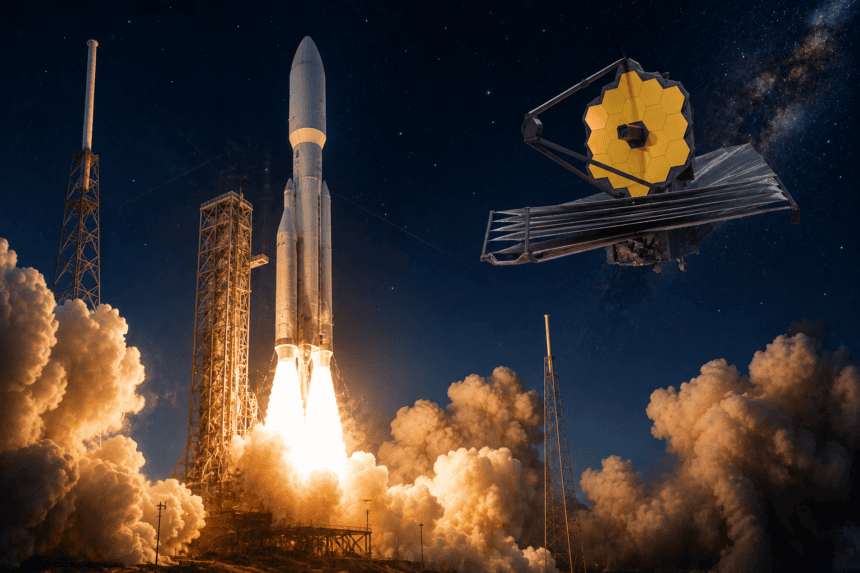
WASHINGTON: NASA has successfully launched the Nancy Grace Roman Space Telescope, a powerful new observatory designed to investigate some of the biggest mysteries of the universe, including dark matter, dark energy and planets beyond our Solar System.
The telescope was launched on August 30, 2026, aboard a SpaceX Falcon Heavy rocket from NASA’s Kennedy Space Center in Florida. The successful launch marks a major milestone for space science and begins a mission expected to significantly expand humanity’s view of the cosmos.
A New Era of Cosmic Exploration
Named after Nancy Grace Roman, NASA’s first chief astronomer and a key figure in the development of space-based astronomy, the telescope has been designed to complement the work of the Hubble Space Telescope and the James Webb Space Telescope.
While Hubble and Webb can produce highly detailed observations of relatively small portions of the sky, Roman is designed to survey enormous areas much more rapidly. Its field of view is expected to be more than 100 times wider than Hubble’s, allowing scientists to observe huge sections of the universe in a single image.
Searching for Dark Matter and Dark Energy
One of Roman’s most important missions will be to help scientists understand dark matter and dark energy.
Dark matter cannot be seen directly, but scientists believe its gravitational influence plays a major role in holding galaxies and larger cosmic structures together. Dark energy, meanwhile, is associated with the accelerating expansion of the universe.
By observing billions of galaxies and mapping how they are distributed across space, Roman could provide new clues about how the universe has evolved and why its expansion is accelerating.
Thousands of New Planets Could Be Discovered
The telescope will also conduct a major search for exoplanets, or planets orbiting stars beyond our Sun.
Scientists expect Roman to discover thousands of previously unknown worlds and provide valuable information about planetary systems throughout the Milky Way. Its observations could also help researchers identify promising targets for future missions searching for potentially habitable planets.
Roman is equipped with a sophisticated coronagraph, an instrument designed to block the overwhelming light of a star so that scientists can attempt to observe planets orbiting around it more directly.
A Million-Mile Journey Into Space
After launch, the telescope will travel roughly 1.6 million kilometres (about one million miles) from Earth to the Sun-Earth Lagrange Point 2, where it will conduct its scientific observations. The location is also used by the James Webb Space Telescope.
Roman is expected to operate for a minimum of five years, with the possibility of an extended mission if its fuel and systems remain healthy.
A Telescope With an Unusual History
The Roman telescope also has a remarkable technological history. Its primary mirror is based on optics originally developed for a US spy-satellite programme and later provided to NASA.
The technology was extensively modified and transformed from its original surveillance purpose into an astronomical instrument capable of studying distant galaxies, stars and planetary systems.
Why the Mission Matters
Scientists expect Roman to create one of the most comprehensive maps of the universe ever produced. Its observations could cover more than two billion galaxies, providing an unprecedented amount of data about cosmic structures and the history of the universe.
The telescope will not replace Hubble or Webb. Instead, it will work alongside them, providing wide-angle surveys that can identify interesting objects and regions for more detailed observations by other telescopes.
The successful launch therefore represents more than the deployment of another space telescope. Roman could give scientists a fundamentally broader view of the universe and help answer questions about how galaxies formed, why the universe is expanding faster and how common planetary systems may be.