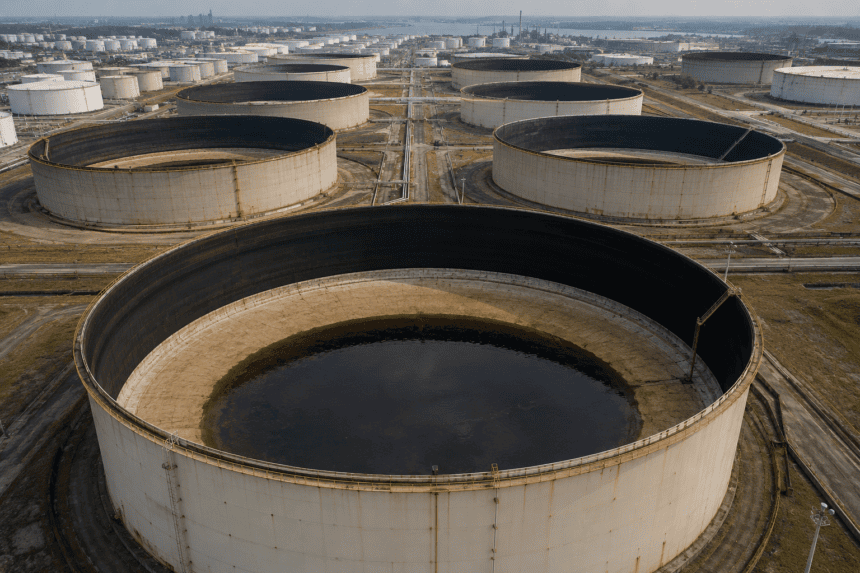
The world’s massive strategic oil storage facilities are sitting largely hollow, holding just 22 million barrels in capacity that is designed to accommodate 90 million. These cavernous steel reservoirs, once the bedrock of energy security, now stand as a stark indicator of shifting market dynamics and the high cost of maintaining stockpiles in a volatile price environment.
For decades, these tanks acted as a buffer against geopolitical shocks. When prices dipped, nations filled them. When supply chains fractured, they tapped the reserves to keep the economy moving. Today, that strategy is fraying. Maintaining a massive inventory isn’t just about the oil itself; it’s about the staggering overhead of infrastructure maintenance, security, and the interest costs tied to keeping capital locked in a commodity that depreciates in storage.
The math simply doesn’t work for many operators anymore. With global crude markets experiencing “backwardation”—a state where current prices are higher than future prices—there is no financial incentive to hold inventory. Traders prefer to sell immediately rather than pay for the privilege of storing oil that will likely be worth less later.
Industry analysts point to a broader trend of “just-in-time” energy management. Governments and private firms are increasingly betting that supply chain agility—the ability to pivot between suppliers—is more effective than maintaining massive, static stockpiles. It’s a risky gamble. Relying on the flow of tankers across the Red Sea or through the Strait of Hormuz leaves zero margin for error when a conflict flares or a shipping lane closes.
The 68 million barrels of empty space aren’t just an inefficiency; they are a liability. When the next supply disruption hits, the ability to release millions of barrels into the market to stabilize prices will be severely hampered. The tanks are there, the pipes are ready, but the oil that used to provide a sense of security has vanished from the balance sheets.
Energy policy experts argue that this trend reflects a fundamental shift in how the world views energy risk. The focus has moved away from physical hoarding toward financial hedging. But as global tensions rise and supply chains prove increasingly fragile, the empty tanks represent a silent vulnerability that markets may soon be forced to confront.
The question isn’t whether the capacity is available—it’s whether the world can afford to leave it empty when the next crisis arrives.