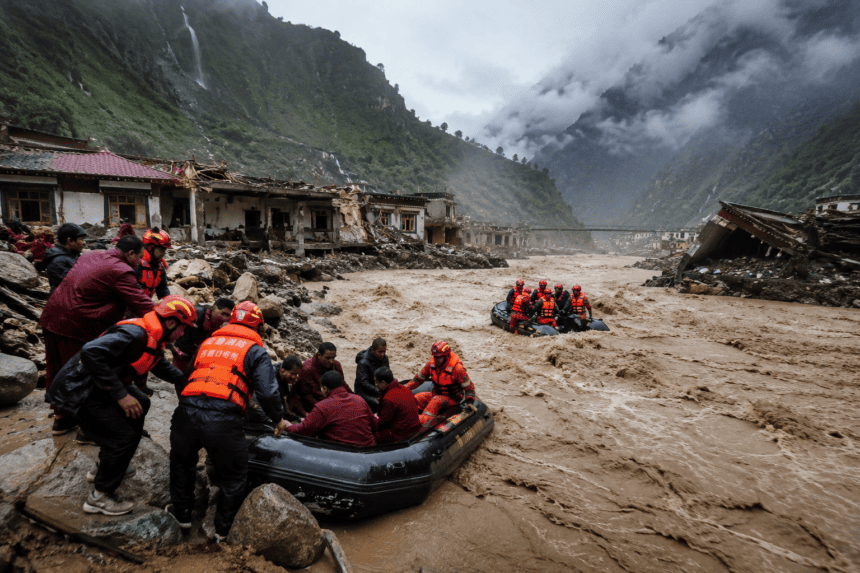
Heavy monsoon rains have triggered catastrophic flooding and landslides along the Nepal-China border, leaving nearly 1,000 people dead. Thousands more remain missing as rescue teams struggle to reach remote mountain villages buried under mud and debris.
The disaster struck early Tuesday, catching residents off-guard in the high-altitude regions of the Sindhupalchok and Rasuwa districts. Entire settlements were swept away as swollen rivers burst their banks, fueled by record-breaking rainfall that has battered the Himalayas for three consecutive days.
“We heard a roar like a jet engine, then the side of the mountain simply vanished,” said Tsering Sherpa, a survivor from a village near the Tatopani border crossing. He managed to escape to higher ground, but his home and livestock are gone.
Local authorities are overwhelmed. The destruction of key bridges and the blockage of the Arniko Highway—the primary artery connecting Kathmandu to the Chinese border—have severed supply lines. Helicopters are grounded due to low visibility and relentless rain, forcing rescue workers to navigate treacherous, unstable terrain on foot.
The scale of the missing is staggering. District administrators report that at least 2,500 people are unaccounted for, though communication blackouts in the mountainous terrain make verification nearly impossible. Many fear the death toll will climb significantly once search crews penetrate deeper into the valley floors.
Geologists have warned for years that the region’s fragile soil composition, combined with rapid, unplanned infrastructure development, made such a disaster an inevitability. These warnings, however, were largely ignored by regional planners focused on boosting cross-border trade.
“This isn’t just bad weather,” said Dr. Arjun Karki, a climate analyst based in Kathmandu. “It’s a structural failure. We’ve built in high-risk zones without proper drainage or reinforcement, and now we’re paying the price.”
As the water begins to recede in some areas, the focus is shifting from search and rescue to the grim reality of recovery. With thousands displaced and facing a freezing night in temporary shelters, the government has requested emergency international aid.
For the families waiting at the base of the mountains, hope is fading with the setting sun. The rain has eased, but the silence from the upper villages is absolute.