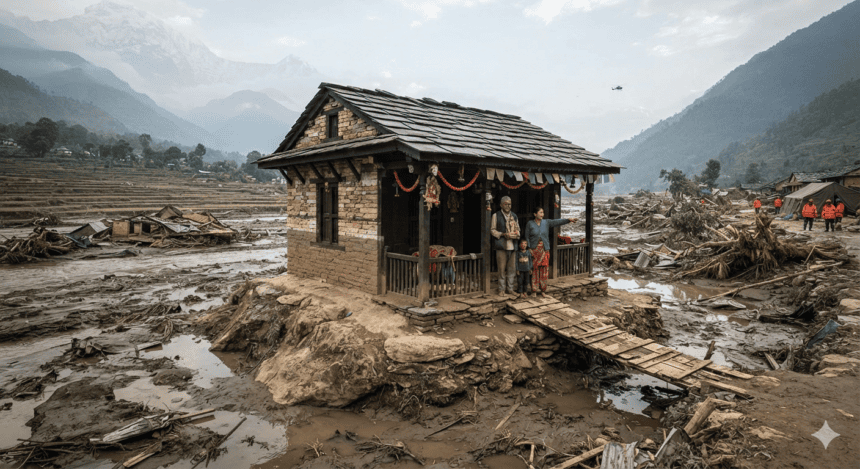
MELAMCHI, NEPAL — In a landscape scoured clean by the Indrawati River’s recent, catastrophic floods, one structure remains. While neighbors’ homes were pulverized into silt and debris, a single, two-story house stands defiant on the riverbank, its foundation miraculously intact.
The house, owned by a local farmer, has become a symbol of both bewilderment and survival in a region where the floodwaters claimed dozens of lives and erased entire settlements in hours.
The river, swollen by unprecedented monsoon rains, surged with such force that it rerouted its course. It tore through concrete embankments and swallowed stone-and-mud dwellings as if they were made of paper. Yet, this specific home—sited on a bend that took the brunt of the torrent—refused to yield.
“We watched the water claw at the earth beneath the porch,” said Ramesh Shrestha, a neighbor who lost his own home nearby. “We expected it to vanish by midnight. By dawn, the river had moved on, and the house was still there.”
Engineers and hydrologists are already pointing to a combination of factors. The house sits on a slightly raised rock shelf, and its foundation was reinforced with deep-set, locally sourced stone masonry that proved more resilient to the shifting silt than the modern, poorly reinforced concrete structures that collapsed around it.
There is a grim irony in its survival. While the building stands, it is now an island—cut off from the road, the power grid, and the community that once surrounded it.
“It’s a miracle of engineering, or perhaps just a cruel stroke of luck,” said a local disaster response official currently surveying the damage. “It’s still standing, but there is nothing left to return to.”
The government has yet to release a full assessment of why this specific area suffered such total destruction, though climate experts warn that the Indrawati’s changing geography is a direct result of deforestation in the upper catchment areas.
For now, the house remains a solitary witness to the fury of the flood. It serves as a stark reminder that in the face of shifting rivers and changing climates, survival often comes down to the smallest of margins.