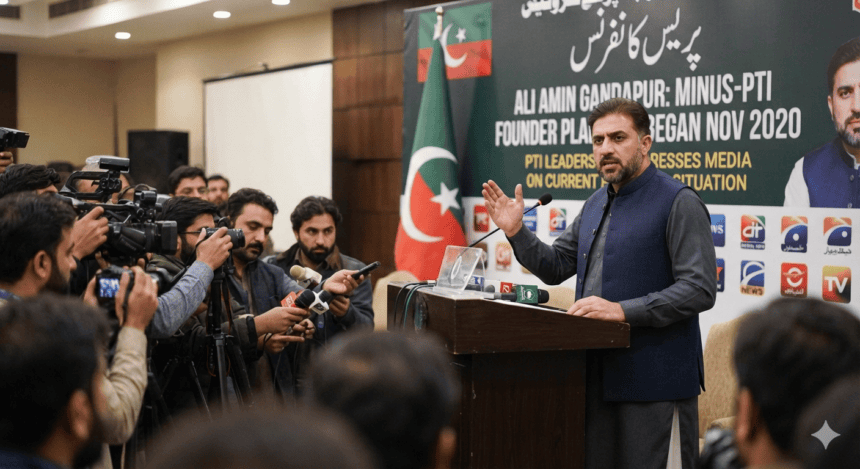
Khyber Pakhtunkhwa Chief Minister Ali Amin Gandapur has leveled a fresh charge against the country’s power brokers, claiming the campaign to sideline PTI founder Imran Khan began long before his ouster from office.
Speaking to party workers and supporters, Gandapur asserted that the blueprint for a “minus-Imran Khan” political landscape was finalized as early as November 2020. This timeline pushes the alleged conspiracy back to when the PTI held the federal government, suggesting that internal and external friction was brewing well before the 2022 vote of no-confidence.
The Chief Minister’s rhetoric marks a sharp escalation in the ongoing standoff between the provincial administration in Peshawar and the federal establishment. By pinning the start date to 2020, Gandapur isn’t just criticizing the current coalition government; he is framing the entire tenure of the PTI administration as a period under constant, calculated siege.
“They had decided then that he had to go,” Gandapur said, though he stopped short of naming specific individuals in the military or civil bureaucracy. He argued that the current legal cases and the incarceration of the former prime minister are merely the final stages of a plan that took root years ago.
The ruling coalition in Islamabad has consistently dismissed such narratives as desperate attempts to gain political sympathy. Spokespeople for the government maintain that the PTI founder’s legal battles are the result of corruption cases and procedural violations, not a coordinated political purge. They argue that Gandapur’s focus on historical grievances is a distraction from the governance challenges currently facing Khyber Pakhtunkhwa.
For the PTI, however, the 2020 timeline serves a clear purpose: it reinforces the party’s narrative of victimization. Supporters view the claim as proof that the system—not the party’s own policy failures—is responsible for the current state of affairs.
Gandapur’s comments arrive at a volatile moment. With PTI leadership pushing for nationwide protests and the federal government tightening its grip on security, the political temperature is climbing. By digging into the past, the Chief Minister is signaling that the party has no intention of moving on—or playing by the established rules of the game.
Whether this claim shifts public opinion or merely hardens existing divides remains the core question. For now, the narrative remains locked in a battle of versions, with neither side showing any sign of backing down.