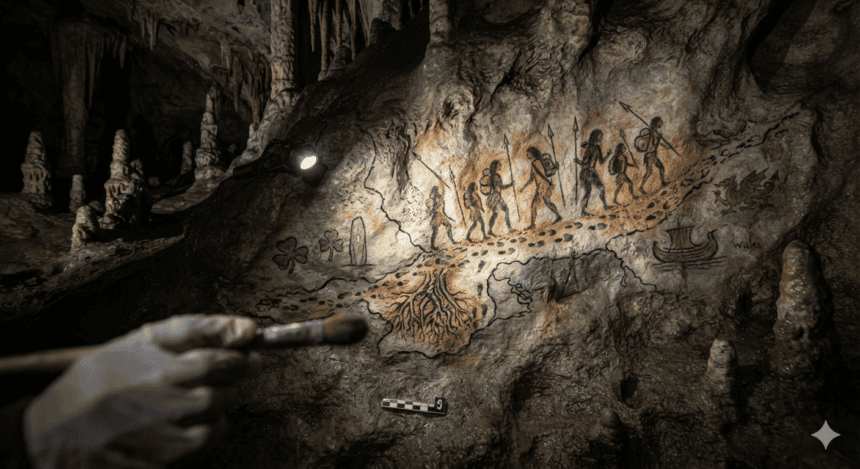
CORK — Archaeologists have uncovered a series of prehistoric carvings in a remote coastal cave in West Cork, providing the first physical evidence that Ireland’s initial inhabitants likely crossed from Wales by foot during the last Ice Age.
The discovery centers on a limestone chamber where researchers identified geometric patterns and animal depictions etched into the rock face. Carbon dating of organic material embedded in the grooves places the art at approximately 12,000 years old. This timeline aligns with the “Doggerland” era, when sea levels were significantly lower, creating a land bridge between the British Isles and the Irish coast.
For decades, the prevailing theory suggested Ireland was colonized by sea-faring groups from the Iberian Peninsula. This new evidence challenges that narrative entirely.
“The style of these etchings mirrors artifacts found in the caves of Pembrokeshire,” said Dr. Elena Vance, the lead researcher on the project. “We aren’t looking at a maritime migration here. We are looking at a walking trail.”
The carvings depict what appear to be red deer and wild boar — species that were moving north as the glacial ice sheets retreated. If these early humans were tracking the same herds, they would have followed the coastal plains across the Irish Sea basin, which was then a vast, marshy tundra.
The site remained hidden until a local climber noticed unusual markings while sheltering from a storm last November. Since then, the site has been kept under wraps to prevent damage to the delicate limestone.
While the discovery is significant, it raises as many questions as it answers. If these settlers walked into Ireland, why is there such a limited archaeological footprint of their presence?
“We’ve found a single room of art, but we haven’t found their hearths or their tools,” Dr. Vance noted. “It suggests these groups were transient — hunters following a seasonal rhythm, moving back and forth between the Welsh coast and the Irish interior before rising sea levels eventually severed the path.”
The team plans to return to the cave next spring to conduct a wider survey of the surrounding cliffside. For now, the markings serve as a rare, silent record of a migration path that disappeared beneath the waves millennia ago.