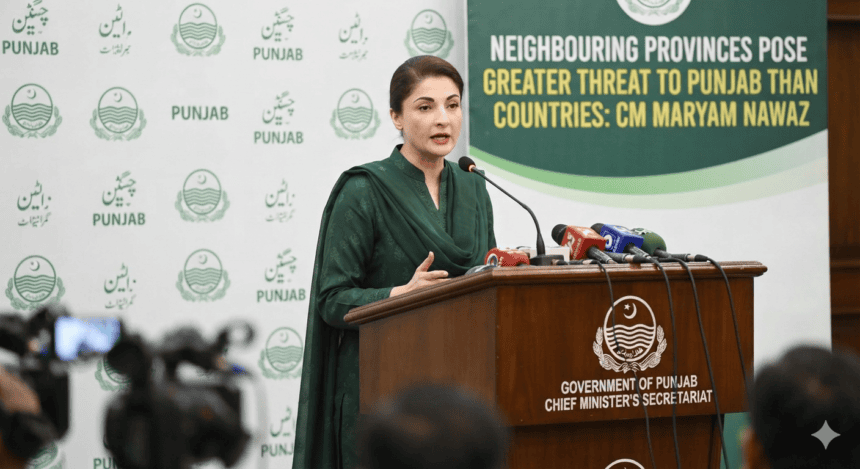
Punjab Chief Minister Maryam Nawaz has identified internal provincial instability as a more pressing security concern than external foreign threats. Speaking at a high-level administrative meeting in Lahore, she argued that the political and economic friction emanating from neighboring provinces is currently destabilizing Punjab’s governance more than any international adversary.
The Chief Minister’s remarks come at a time of heightened political polarization between the PML-N-led government in Punjab and the PTI-led administration in Khyber Pakhtunkhwa. The growing rift has manifested in frequent protests, blockades, and a breakdown in inter-provincial communication channels.
“We aren’t looking at borders,” she told provincial officials. “The real challenge to our stability is coming from right next door.”
Her administration contends that the frequent mobilization of provincial resources for political agitation in Islamabad—often spearheaded by KP leadership—is draining Punjab’s administrative bandwidth. The Chief Minister pointed to the recurring disruptions in trade routes and public order as evidence of a “deliberate attempt” to cripple the province’s economic engine.
Critics, however, view the statement as an attempt to deflect from the province’s own internal governance challenges. Opposition leaders have been quick to label the rhetoric as an effort to justify a crackdown on political dissent, framing the Chief Minister’s comments as a way to criminalize provincial political rivalry.
The friction is not merely rhetorical. Security officials have noted that the inter-provincial tension has complicated intelligence sharing and law enforcement operations, particularly regarding cross-border movement during periods of civil unrest.
The Chief Minister’s office has not yet specified what administrative measures, if any, will be taken to address this perceived threat. For now, the statement signals a hardening stance from Lahore, suggesting that the era of inter-provincial cooperation is being replaced by a defensive, and potentially confrontational, posture.
Whether this rhetoric leads to a formal policy shift or remains a tool for political posturing, the divide between the provinces is deeper today than at any point in the last decade. As provincial administrations prioritize political survival over regional integration, the cost of this gridlock is falling squarely on the public.