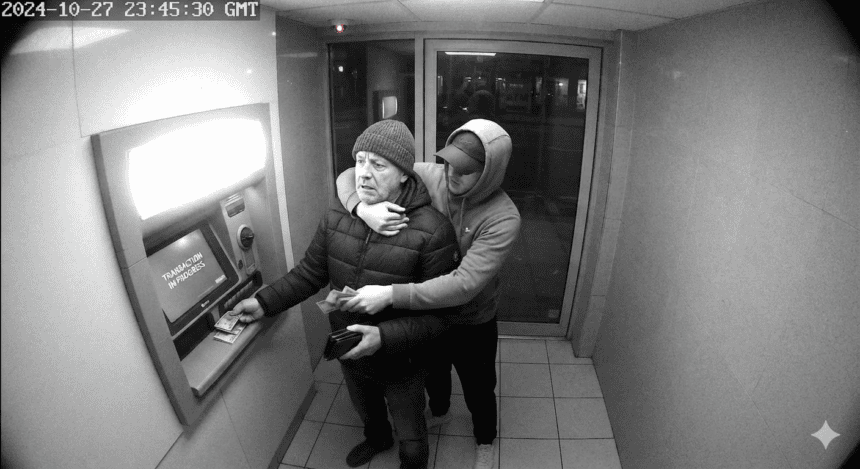
The security footage is clear, cold, and damning. A man stands at an ATM in a quiet corner of the city, struggling with a transaction. A passerby approaches, gestures toward the keypad, and offers assistance. Within seconds, the encounter turns into a violent mugging.
The incident, which took place late Tuesday evening, follows a familiar but dangerous pattern. As the victim fumbled with his card, the suspect stepped into his personal space under the guise of being helpful. The footage shows the suspect quickly pinning the victim against the machine, rifling through his pockets, and snatching his wallet before sprinting toward a waiting vehicle.
Local police are now using the video to track the assailant, who remains at large. Investigators say the suspect likely targeted the victim after watching him enter his PIN from a distance—a tactic known as “shoulder surfing” that has seen a spike in local reports over the last month.
“People need to realize that a stranger at an ATM is rarely there to help,” said a local precinct commander. “If the machine isn’t working, walk away. Don’t let someone get close enough to see your credentials or your cash.”
This isn’t an isolated event. Bank security experts suggest that ATM lobbies—once considered safe havens—have become prime hunting grounds for opportunistic thieves. The strategy is simple: exploit a moment of technological frustration to create a physical opening.
The victim, who was left shaken but physically unharmed, told officers the suspect was polite and calm before the sudden escalation. That sense of normalcy is exactly what the perpetrator relied on to lower the victim’s guard.
As the investigation continues, police are urging residents to treat any unsolicited help at a terminal as a red flag. For now, the footage is circulating on social media, serving as a stark reminder that in high-traffic areas, your biggest security risk might be the person standing right behind you.