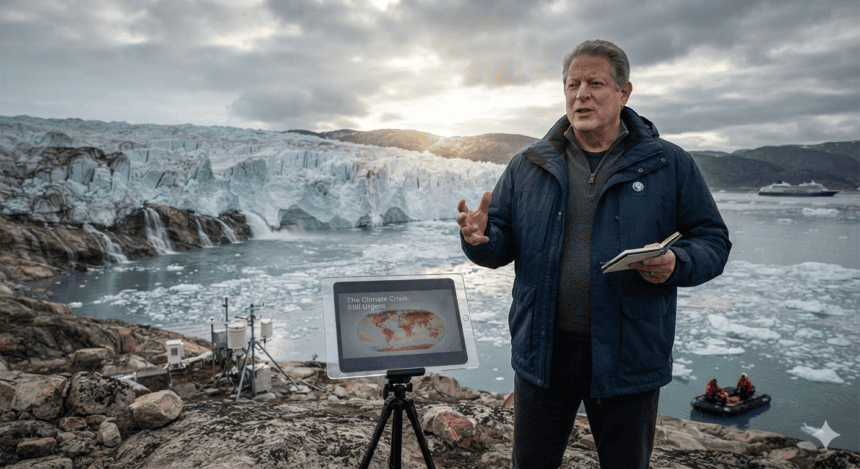
Al Gore is still sounding the alarm. Decades after *An Inconvenient Truth* turned him into the face of the climate movement, the former Vice President is doubling down on his warnings, arguing that the transition away from fossil fuels is moving too slowly to avert catastrophe.
He isn’t softening his tone. In recent speaking engagements and advocacy summits, Gore has pivoted from the broad warnings of the early 2000s to a more granular, often aggressive push against the influence of the oil and gas industry. For Gore, the “so what” is no longer just about melting ice caps; it’s about the systemic capture of political processes that keep renewable energy on the sidelines.
Gore’s approach has shifted from education to confrontation. He now focuses heavily on the “greenwashing” tactics employed by major corporations, frequently calling out companies that pledge net-zero targets while simultaneously expanding exploration efforts. Critics argue that his messaging has become predictable, yet the data he cites—record-breaking global temperatures and the increasing frequency of extreme weather events—remains difficult to dismiss.
The former Vice President’s influence, however, faces a new hurdle: climate fatigue. As economic pressures and geopolitical instability dominate headlines, keeping the public focused on a long-term existential threat has become an uphill battle.
“The fossil fuel industry is spending billions to keep the status quo,” Gore told a recent assembly of climate activists. He characterized the current moment not as a scientific debate, but as a “battle for the soul of the political system.”
Behind the rhetoric lies a stark reality. Recent reports from the International Energy Agency suggest that while renewable capacity is growing at a record pace, it still trails the investment needed to meet the Paris Agreement goals. Gore’s role has largely evolved into that of a high-profile watchdog, using his platform to bridge the gap between scientific consensus and public policy.
Whether his message still resonates in a polarized media environment remains the core question. He is no longer just the politician turned activist; he is a persistent, often polarizing figure whose presence serves as a constant reminder that for all the talk of green transitions, the global reliance on carbon remains largely intact.
He isn’t planning on stepping back. As he told his audience last month, the alternative to his continued pressure is simply “giving up on the future.”