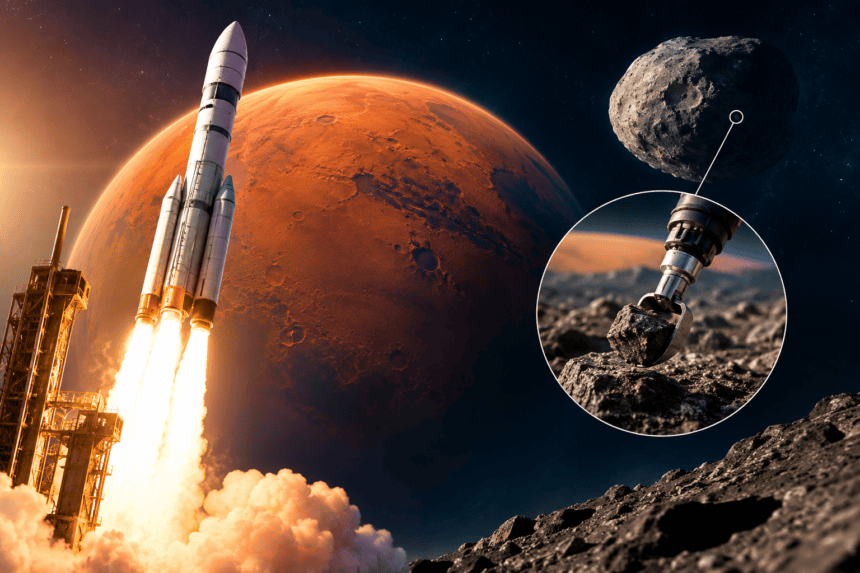
Japan’s space agency is moving into the final stages of its Martian Moons exploration (MMX) mission, an ambitious plan to land a probe on Phobos and return the first-ever samples of a Martian moon to Earth.
The Japan Aerospace Exploration Agency (JAXA) confirmed the mission is now targeting a 2026 launch window. The delay from its original 2024 slot follows the recent debut and testing phases of the H3 rocket, the heavy-lift vehicle tasked with carrying the probe beyond Earth’s orbit.
This isn’t just another flyby. MMX aims to solve a long-standing debate in planetary science: is Phobos a “captured” asteroid trapped by Mars’ gravity, or is it a jagged piece of Mars itself, blasted into orbit by a massive ancient impact?
The answer is buried in the dust.
The spacecraft will spend three years orbiting Mars, surveying both Phobos and the smaller moon, Deimos. Its primary objective, however, requires a precision landing. The probe will touch down on Phobos’ low-gravity surface for several hours to collect at least 10 grams of soil using a specialized coring mechanism.
JAXA isn’t working alone. NASA is providing a gamma-ray and neutron spectrometer to help the probe identify what the moon is made of before it even lands. The French space agency (CNES) and the German Aerospace Center (DLR) are contributing a small rover that will drop onto the surface to scout the terrain, ensuring the main lander doesn’t hit a boulder or sink into a dust trap.
The stakes for the return leg are even higher. After collecting the samples, the probe will blast off from Phobos, orbit Mars again, and eventually head back to Earth. If everything stays on schedule, the sample capsule will streak through Earth’s atmosphere in 2031.
“We want to understand how water and organic matter were transported in the early solar system,” a JAXA mission lead told reporters during a recent technical briefing. The agency believes Phobos might act as a time capsule, holding clues about the evolution of the Martian atmosphere and the habitability of the Red Planet.
Success would solidify Japan’s lead in sample-return technology, following its previous Hayabusa missions which successfully brought back dust from near-Earth asteroids. This time, the team is going much further. Bringing a piece of a Martian moon back to a lab on Earth would provide a level of chemical analysis that rovers like Perseverance simply cannot perform in the field.
The 2026 launch will be the ultimate test for the H3 rocket. After a failed inaugural flight in 2023 and a successful follow-up this year, the pressure is on JAXA to ensure the vehicle is ready for its most prestigious passenger yet.