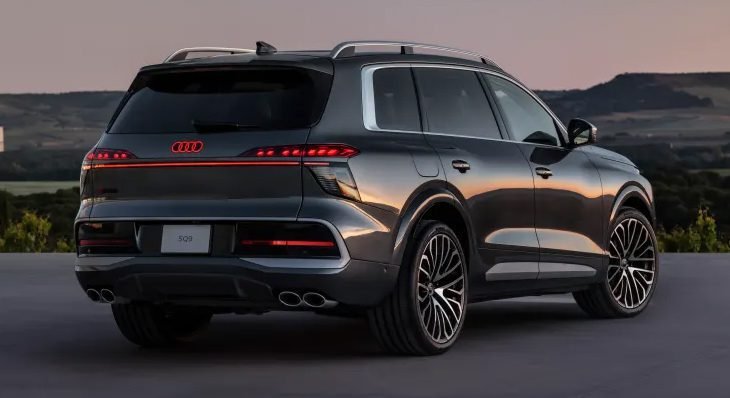
INGOLSTADT: Audi has introduced a new generation of digital lighting in its Q9 flagship SUV, featuring three-dimensionally curved OLED taillights designed to improve visibility, personalise the vehicle’s appearance and communicate safety warnings to other road users.
The German automaker describes the system as the first use of curved digital OLED panels in a production vehicle. The technology uses ultra-thin glass measuring just 0.1 millimetres, allowing the lighting panels to follow the contours of the SUV’s rear.
Audi’s third-generation digital OLED system contains 512 individually controllable segments distributed across six panels. The outer curved panel has 99 segments, making it the largest OLED panel the company has installed in a production vehicle.
The design improves visibility from wider angles, particularly from the sides, while offering drivers up to eight digital lighting signatures. For the first time, the system can also display partially activated patterns to create more dynamic lighting effects.
Beyond appearance, the technology incorporates safety-focused features. When the vehicle detects certain hazards or a breakdown, its rear lights can display a warning symbol resembling a hazard triangle to alert approaching motorists.
The Q9 also combines its OLED taillights with digital Matrix LED headlights featuring micro-LED technology. Its advanced turn signals can project visual indicators onto the road to make turning and lane changes more noticeable to pedestrians, cyclists and other drivers.
Audi first introduced OLED rear lighting in the TT RS in 2016 before expanding the technology with individually controllable segments and additional safety functions in subsequent models.
With the Q9, the company is continuing its push to turn vehicle lighting into a digital communication system that combines exterior styling, personalisation and driver assistance.