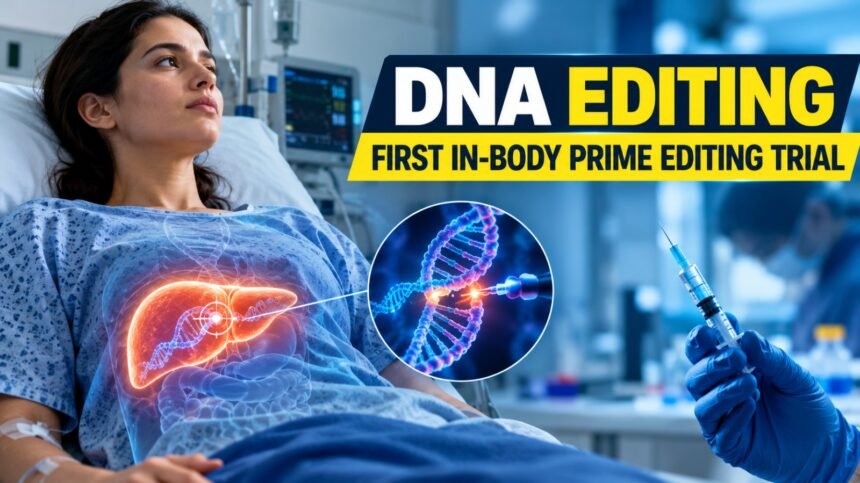
The experimental treatment uses a technology called **prime editing** and is being investigated for Wilson disease, a rare inherited condition that prevents the body from properly removing excess copper. As copper builds up, it can damage the liver, nervous system and other organs.
The treatment, developed by US biotechnology company Prime Medicine, aims to correct a mutation in the **ATP7B gene**, which plays an important role in copper processing. The gene-editing components are delivered through an intravenous infusion and are designed to reach liver cells, where the correction is intended to take place.
Prime editing works somewhat like a molecular search-and-replace tool. It is designed to make specific changes to genetic code, including replacing, inserting or deleting sections of DNA. Researchers hope this approach could eventually address the underlying cause of certain inherited diseases instead of only managing their symptoms.
One important difference is that the treatment is designed to edit DNA inside the body. Some earlier gene-editing approaches required doctors to remove a patient’s cells, modify them in a laboratory and then return them to the body.
However, this development is still at an early experimental stage. Scientists must determine whether the treatment can safely reach the intended cells, make the correct genetic changes and avoid unintended edits. It is not yet known whether the experimental therapy will provide lasting health benefits.
The first participant in the clinical trial received the treatment in October 2026. Initial results are expected in 2027. Until the findings are available, the procedure should be viewed as an important research milestone rather than a proven cure for Wilson disease.