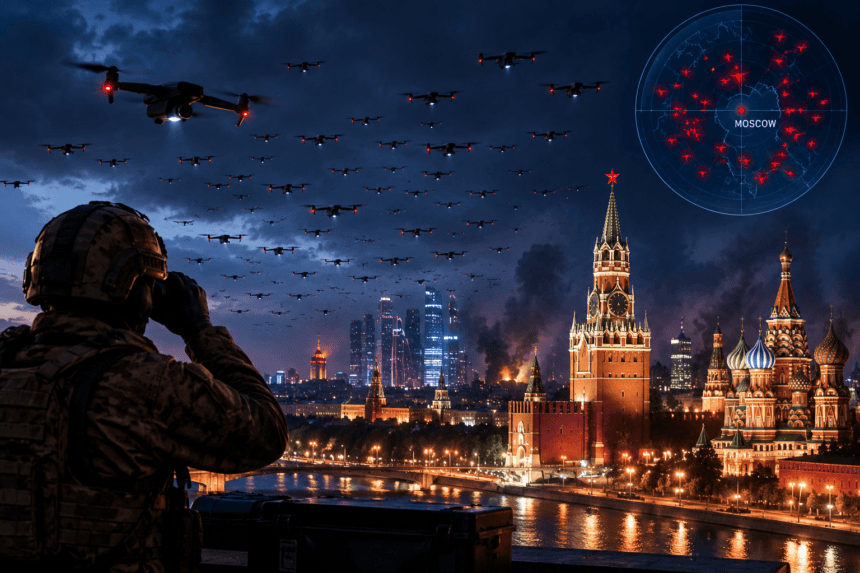
Moscow’s air defenses scrambled through the night as waves of Ukrainian drones targeted the capital, with Russian officials reporting a massive aerial assault involving hundreds of unmanned systems.
The barrage, which began late Tuesday and continued into Wednesday morning, represents the most significant attempt to overwhelm Moscow’s airspace since the conflict escalated in 2022. While Russian military spokesmen claimed their systems intercepted the vast majority of the incoming threats, debris from downed drones caused localized fires and structural damage in residential districts on the city’s outskirts.
Mayor Sergei Sobyanin confirmed the attack was “massive,” though he stopped short of confirming the specific count of 600 drones cited in early intelligence reports. Instead, officials focused on the operational success of the S-400 and Pantsir-S1 defense batteries stationed around the city.
The sheer volume of the strike suggests a shift in Ukrainian tactics. By launching hundreds of low-cost, disposable drones simultaneously, Kyiv appears to be testing the endurance of Russia’s radar coverage and the ammunition stockpiles of its air defense units. It’s a strategy of saturation. If the defenses run dry or the radar becomes blinded by the sheer number of targets, the cost of a single breakthrough becomes catastrophic.
“They are trying to force us into a war of attrition where we burn through expensive interceptor missiles to stop cheap hobbyist drones,” said one independent military analyst in Moscow, speaking on condition of anonymity. “The math doesn’t favor the defender over the long term.”
Russian authorities have restricted movement in several districts south of the city, citing the need to recover unexploded ordnance and conduct safety sweeps. Several major highways leading into the capital were temporarily shuttered, causing morning gridlock that spilled over into the city center.
While the Kremlin remains officially tight-lipped regarding the total number of drones launched, the scale of the debris fields across the Moscow region tells a different story. This is no longer just a series of isolated strikes; it is a sustained attempt to bring the realities of the front line directly to the doorstep of the Russian political elite.
For now, the capital remains functional, but the psychological impact of a night-long air raid siren is a new, uncomfortable reality for millions of Muscovites. As the smoke clears, the question remains whether Russia’s layered defense network can sustain this pace of engagement or if the next wave will find a gap.