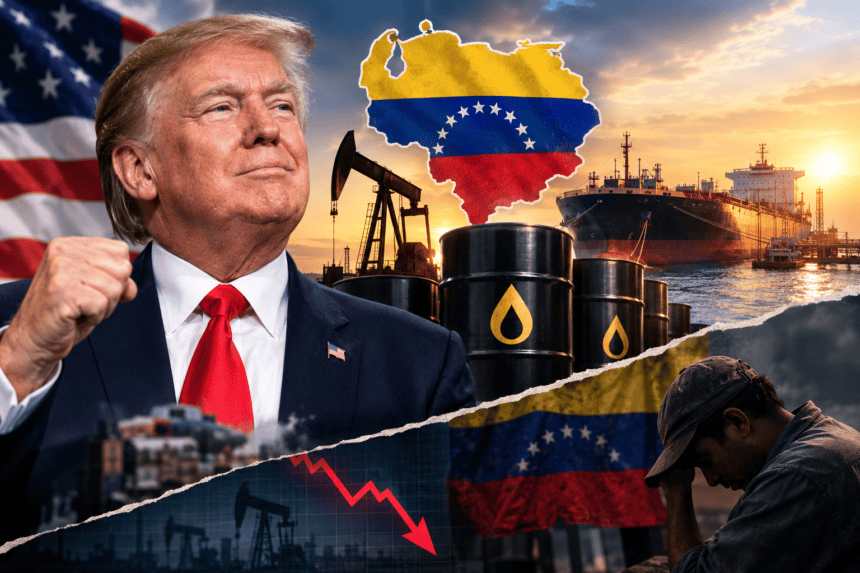
Donald Trump’s campaign promise to “unlock” Venezuelan oil to crash global energy prices is hitting a wall of geopolitical and logistical reality. While the former president frequently pointed to the South American nation’s massive reserves as a quick fix for domestic inflation, energy analysts and industry insiders say the math simply doesn’t add up.
The bottleneck isn’t a lack of oil; it’s a total collapse of infrastructure. Decades of underinvestment, mismanagement, and heavy international sanctions have left Petróleos de Venezuela (PDVSA) struggling to maintain even basic production levels. Even if Washington were to offer a sudden, blanket lifting of sanctions, experts estimate it would take years of multi-billion dollar capital injections just to bring dormant wells back online.
“You can’t just flip a switch,” said Francisco Monaldi, an energy economist at Rice University. “The industry has been hollowed out. Even with a green light today, you’re looking at a long, expensive climb just to reach pre-sanction output levels, let alone a surge that would move global price needles.”
The political friction remains just as stubborn. The Biden administration’s recent history of oscillating between sanction relief and re-imposition highlights the volatility inherent in dealing with the Maduro regime. Investors are wary of long-term commitments when the legal framework for operating in Venezuela is subject to the whims of whoever sits in the Oval Office.
Trump’s rhetoric often glosses over the complexity of heavy crude. Venezuelan oil is notoriously thick, requiring specialized refineries—many of which are located on the U.S. Gulf Coast—to process it into gasoline. Most of these facilities have shifted their operations to handle lighter grades from domestic shale producers. Reconfiguring those refineries to accommodate Venezuelan imports is a capital-intensive project that private companies aren’t eager to bankroll without ironclad guarantees.
The promise of “record” deals also ignores the current state of the global market. Venezuela’s production has hovered around 800,000 to 900,000 barrels per day—a fraction of the 3 million barrels it pumped in the late 1990s. Even if that output doubled, it would barely move the dial on global supply in a market currently consuming over 100 million barrels daily.
For voters, the appeal of cheap gas is a powerful incentive. But as the campaign trail dust settles, the gap between the rhetoric of a “record deal” and the actual mechanics of the oil market is widening.
Energy policy is rarely as simple as a campaign slogan suggests, and in the case of Venezuela, the infrastructure rot may be far deeper than any executive order can reach.