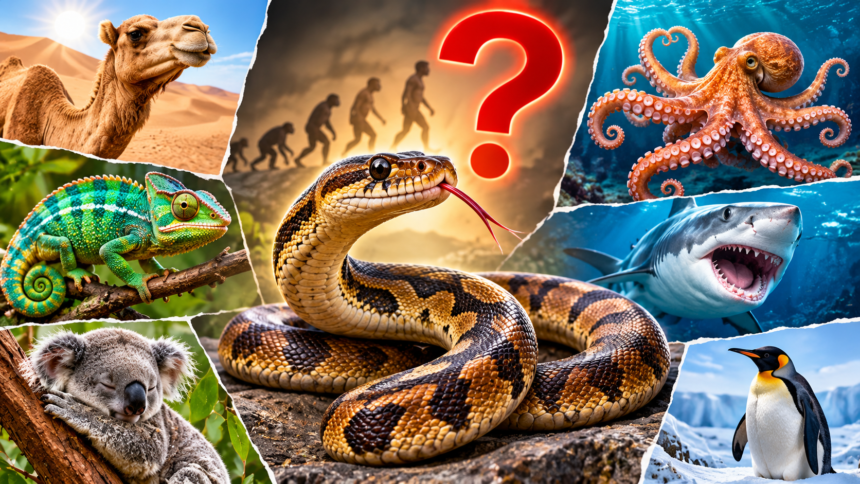
For centuries, biologists looked at snakes and saw a biological anomaly. How does a creature shed four limbs and still thrive? New genetic research finally provides the answer, pointing to a specific “on-off” switch in their DNA that silenced limb development millions of years ago.
It wasn’t just a random mutation. Researchers identified a deletion in a highly conserved genetic sequence—the ZRS enhancer—which typically acts as a control center for limb growth. In snakes, this switch is broken. Without it, the signaling protein that tells a limb to grow never receives the command. The result? A streamlined, subterranean predator that evolved to navigate tight crevices where legs were a liability, not an asset.
This is just one of many animal mysteries finally yielding to modern science. Here are nine others that continue to challenge our understanding of the natural world:
1. The Immortal Jellyfish
*Turritopsis dohrnii* can essentially cheat death. When stressed, injured, or aging, it reverts its cells back to their earliest polyp stage and starts its life cycle over. It’s a biological reset button that defies the standard rules of senescence.
2. The Whale’s Deep-Dive Physiology
Cuvier’s beaked whales can dive nearly 3,000 meters and hold their breath for over three hours. They don’t just endure the crushing pressure; they thrive in it. Scientists are still mapping how their proteins prevent nitrogen bubbles from forming in their blood, a phenomenon that would kill a human instantly.
3. The Monarch Butterfly’s GPS
How does a butterfly that has never visited its destination navigate 3,000 miles to a specific tree in Mexico? They rely on a combination of a sun compass and an internal magnetic map, yet the mechanism for how they inherit this “map” in their DNA remains a subject of intense study.
4. The Greenland Shark’s Longevity
These sharks can live for 400 years. They reach sexual maturity at 150. By studying their slow metabolism and cold-adapted cells, researchers hope to unlock secrets to cellular longevity that could have massive implications for human aging research.
5. The Mystery of Bird Migration
Many bird species navigate across hemispheres with pinpoint accuracy. Recent studies suggest they might actually “see” the Earth’s magnetic field via light-sensitive proteins in their eyes called cryptochromes. It’s a literal sixth sense.
6. The Platypus’s Bizarre Blueprint
When British scientists first saw a platypus pelt in 1799, they thought it was a hoax—a duck’s bill sewn onto a beaver. They lay eggs, produce milk, have venomous spurs, and use electrolocation to hunt. They remain a living example of how evolution experiments with “modular” body parts.
7. The Hibernation Secret
Bears don’t lose muscle mass or bone density during months of hibernation. If a human stayed in bed for six months, they’d be severely weakened. Understanding how bears recycle their own waste products into proteins could change how we treat muscle-wasting diseases.
8. The Octopus’s Distributed Brain
An octopus has nine brains—one central and one in each of its eight arms. Two-thirds of its neurons are in its arms, meaning the limbs can “think” for themselves. It’s a form of intelligence that is fundamentally alien to the vertebrate model.
9. The Cicada’s 17-Year Clock
Periodical cicadas emerge exactly every 13 or 17 years. Both numbers are prime. This isn’t a coincidence; it’s a survival strategy to avoid predator cycles. But the molecular “clock” that counts the years underground remains one of biology’s most guarded secrets.
Nature doesn’t keep these secrets because it wants to be mysterious. It keeps them because it is still actively writing the rules of survival. As our genetic tools sharpen, the line between “impossible” and “evolutionarily brilliant” continues to blur.