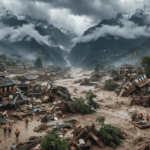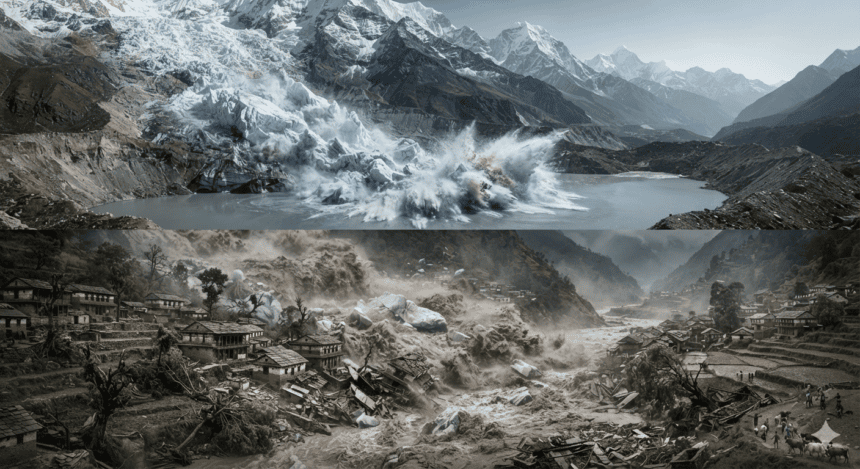
The devastating floods that tore through Nepal’s Melamchi Valley last summer were not caused by simple monsoon rainfall, but by a massive ice avalanche. A new study by international geologists points to a climate-driven collapse that sent millions of cubic meters of debris crashing into the river system.
The findings, published this week, challenge the long-held assumption that Nepal’s flash floods are purely meteorological. Instead, researchers identified a high-altitude glacier collapse as the primary catalyst. When a massive slab of ice broke away from a peak in the Jugal Himal range, it triggered a chain reaction—scouring the landscape, picking up sediment, and transforming the Melamchi River into a lethal slurry of mud and boulders.
“This wasn’t just rain,” said one of the lead researchers involved in the field assessment. “The sheer volume of material moving downstream suggests a massive, sudden release of energy that only a glacier failure could provide.”
The disaster claimed dozens of lives and wiped out critical infrastructure, including the intake facility of the Melamchi Water Supply Project, which provides a lifeline of drinking water to Kathmandu. For months, the capital faced severe shortages as engineers struggled to clear the path of the debris.
The implications for the Himalayan region are stark. As global temperatures rise, the stability of high-altitude glaciers is becoming increasingly unpredictable. Scientists warn that the Melamchi event may be a preview of a “new normal” for mountain communities, where warming peaks no longer hold their ice throughout the summer.
Local authorities are now under pressure to rethink flood mitigation strategies. Traditional early warning systems—designed to detect rising water levels from rainfall—are essentially useless against a sudden, silent collapse of ice from a mountaintop.
Without a better understanding of how these glaciers are shifting, downstream infrastructure remains a sitting duck. The Melamchi disaster proved that the threat isn’t just in the clouds; it’s hanging precariously above the peaks, waiting for the next warm spell to fall.