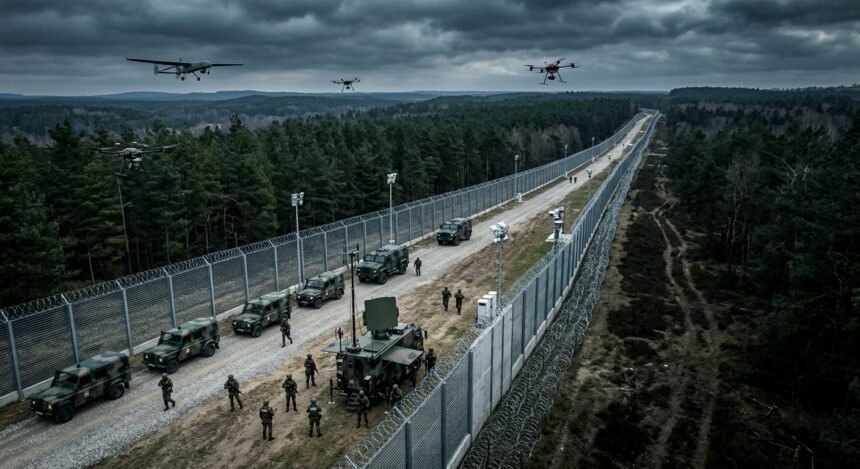
Poland is accelerating the construction of its “East Shield” defensive line, deploying advanced surveillance and physical barriers along its 230-kilometer border with the Russian exclave of Kaliningrad. The move marks a shift from reactive border patrols to a permanent, multi-layered military footprint.
The project, backed by a 10 billion zloty ($2.5 billion) investment, aims to deter potential hybrid warfare tactics. Officials in Warsaw point to the persistent flow of migrants orchestrated by Moscow and Minsk as a primary security threat, but the new fortifications are designed for a much larger contingency.
“We are not just building a fence,” a defense ministry spokesperson said Tuesday. “We are creating an integrated system of sensors, anti-tank obstacles, and electronic warfare capabilities that make any unauthorized crossing—or incursion—an immediate tactical failure for the adversary.”
The timeline is aggressive. Engineering units have already begun laying concrete anti-tank blocks and digging trenches in strategic sectors of the Warmian-Masurian Voivodeship. By the end of this year, the government expects the first phase of the “smart” perimeter to be fully operational.
Critics have raised questions about the cost and the potential for further escalating regional tensions. Moscow’s state media has characterized the construction as a “provocative display of NATO expansionism,” though Polish authorities maintain that the border hardening is a sovereign necessity. They aren’t looking for a fight, but they’ve made it clear they’re done leaving the door unlocked.
For Poland, the stakes extend beyond territorial integrity. As the largest NATO member on the alliance’s eastern edge, Warsaw views its border as the litmus test for European resolve. The message is simple: the era of porous, low-security borders is over.
The work will continue through 2028, eventually encompassing the entirety of Poland’s eastern frontier, including the border with Belarus. Whether this creates a genuine deterrent or simply deepens the divide, Poland is betting that physical reality is the only language that currently resonates in the Kremlin.