Sindh’s education boards are set to undergo a structural shake-up. Starting in 2026, the provincial government will implement a new set of recruitment rules designed to curb political appointments and enforce merit-based hiring across all boards in the province.
The decision stems from years of persistent complaints regarding nepotism and procedural irregularities within the boards. For decades, these institutions have operated under opaque hiring practices, often prioritizing connections over credentials. The new policy aims to strip that power away from individual board chairmen and centralize oversight.
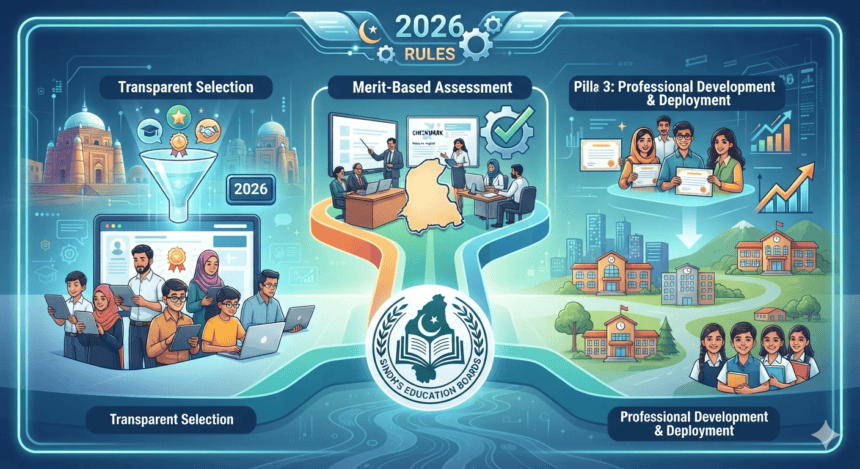
Under these mandates, the recruitment process will move away from internal board committees. Instead, the Sindh government intends to utilize a third-party testing service to handle candidate screening. This move is intended to eliminate the “interview-only” culture that has historically allowed unqualified candidates to secure key administrative and clerical positions.
“The system is broken,” a senior official at the Sindh Universities and Boards Department said. “We are seeing a decline in institutional efficiency because the people being hired aren’t qualified to manage examination data or handle sensitive financial records.”
The rules won’t just apply to new staff. The policy includes a mandatory audit of current employees hired within the last five years. Those who cannot provide verified documentation or who were hired outside of established budgetary protocols could face termination or a mandatory re-evaluation of their status.
The move has already sparked friction. Several board employees’ unions have signaled opposition, citing concerns that the provincial government is overstepping its authority and infringing on the boards’ traditional autonomy.
Despite the pushback, the provincial cabinet remains firm. They argue that the boards have become bloated with redundant staff, draining resources that should be funneled into examination reforms and infrastructure.
The success of these rules will hinge on enforcement. Previous attempts to reform Sindh’s education sector have often stalled when faced with political pressure from union leaders and local power brokers. If the 2026 deadline holds, the province will finally have a standardized, digital-first hiring pipeline. If it falters, it will be just another set of guidelines gathering dust in a government office.