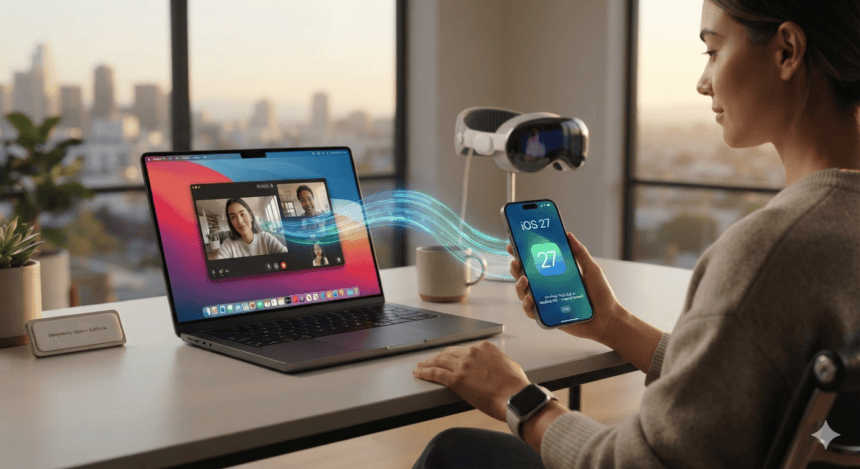
Apple has quietly pushed a significant update to its ecosystem with the rollout of iOS 27, introducing a sophisticated Handoff feature that bridges the gap between hardware devices more fluidly than previous iterations. The update allows users to seamlessly move active tasks, media playback, and even complex app states between an iPhone and other Apple hardware with near-zero latency.
Engineers at Cupertino have moved beyond the simple clipboard and URL sharing of the past. The new Handoff utilizes the Ultra-Wideband (UWB) chip to detect spatial proximity, meaning a user can now move their phone toward a Mac or iPad to trigger an immediate, context-aware transfer. It’s a hardware-software handshake that feels less like a manual command and more like a natural extension of the device.
The move addresses a long-standing friction point for power users: the “dead air” between devices. Previously, Handoff relied on a combination of Bluetooth and iCloud syncing, which often resulted in a laggy user experience or failed connections. By shifting the heavy lifting to spatial awareness and local mesh networking, the process is now instantaneous.
Privacy advocates are already watching the implementation closely. Because the feature relies on constant spatial scanning to determine when a user wants to “hand off” a task, it requires persistent access to the UWB sensor. Apple maintains that all proximity processing happens on-device, keeping the data isolated from cloud servers.
The update is currently rolling out to all iPhone 16 and later models. Older devices will support the feature, but they’ll lack the spatial precision required for the “proximity-trigger” functionality, forcing users to rely on the traditional manual menu selection.
For Apple, this is a clear play to deepen the “walled garden” experience. By making the transition between devices invisible, the company isn’t just selling phones; it’s selling a single, unified computing experience that makes switching to a competitor’s hardware feel significantly more cumbersome.
Whether this will entice users to buy more ecosystem-locked hardware remains to be seen. For now, it’s a technical win that solves a genuine annoyance, provided you’re willing to stay within Apple’s hardware lines.