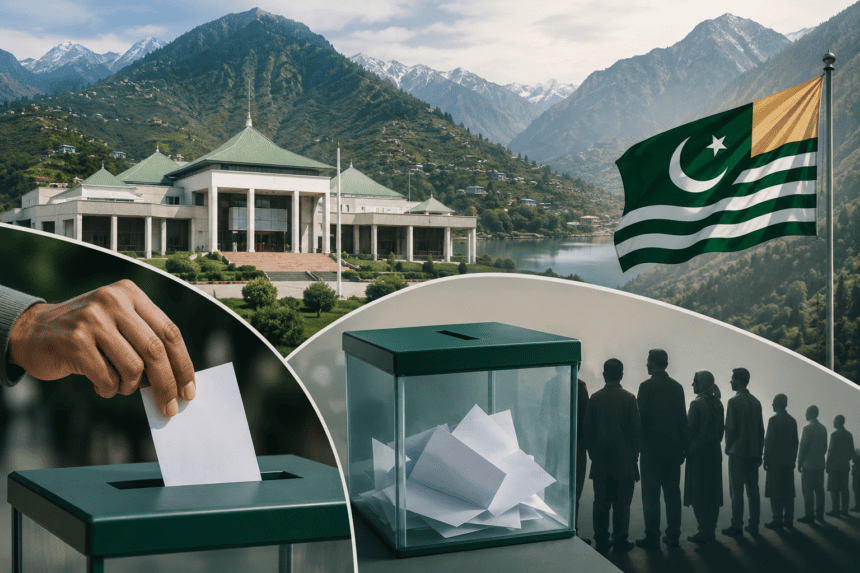
The Azad Jammu and Kashmir (AJK) Legislative Assembly is approaching a critical juncture as the 2026 general elections loom on the horizon. With the current five-year term nearing its end, political maneuvering in Muzaffarabad is intensifying, shifting the focus from legislative business to electoral strategy.
The upcoming polls carry significant weight. The region remains a focal point of regional geopolitics, and the local administration faces the dual challenge of addressing deep-seated economic grievances—specifically high electricity costs and wheat subsidy cuts—while maintaining a stable political environment.
The Political Landscape
The incumbent Pakistan Tehreek-e-Insaf (PTI) government, which secured a majority in the 2021 elections, finds itself in a vastly different landscape today. The shifting allegiances of elected representatives and the emergence of new political realignments mean the path to a simple majority is no longer guaranteed.
Opposition parties, including the Pakistan Peoples Party (PPP) and the Pakistan Muslim League-Nawaz (PML-N), are aggressively positioning themselves to capitalize on public frustration. Recent by-elections and local government polls have served as a litmus test for these parties, revealing a thinning margin of support for the ruling party in several key constituencies.
Key Issues Driving the Vote
Voters are signaling that the economy—not just national rhetoric—will dictate their choice at the ballot box. The 2026 campaign is expected to center on:
* Subsidy Reform: Public protests over the reduction of wheat flour subsidies have created a trust deficit between the people and the provincial government.
* Energy Costs: Residents in AJK, despite living near major hydropower projects like the Neelum-Jhelum, are paying record-high tariffs. Any party offering a viable plan to lower these costs will hold a distinct advantage.
* Infrastructure and Development: Despite past promises, remote areas of the Neelum and Haveli districts continue to struggle with basic connectivity and healthcare access.
The Electoral Challenge
The Election Commission of AJK faces the logistical hurdle of managing a population that is increasingly politically active. Voter turnout in the last cycle was robust, but analysts suggest that apathy could rise if voters feel that the major parties are more interested in power-sharing deals than in addressing bread-and-butter issues.
“The 2026 election won’t be won on slogans alone,” said a senior political analyst based in Muzaffarabad. “The party that provides a concrete, transparent roadmap for economic relief for the common man in AJK is the one that will secure the treasury benches.”
As the election date approaches, the focus will shift to candidate selection. History shows that in AJK, tribal affiliations and local clan dynamics often outweigh national party manifestos. With the deadline for filing nominations still months away, the true shape of the race remains fluid—but the pressure on the current leadership to deliver results before the assembly dissolves is mounting by the day.