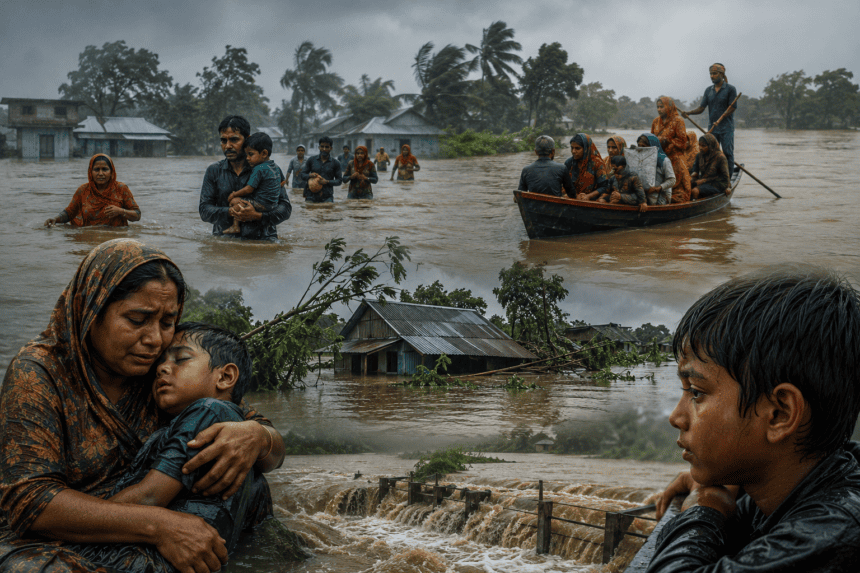
The death toll from relentless monsoon flooding across Bangladesh has climbed to 50, with millions of people caught in the path of rising waters. Government disaster management officials confirmed the figure Thursday, marking a sharp escalation in a crisis that has left thousands displaced and entire villages submerged.
The districts of Feni, Noakhali, and Comilla are the hardest hit. In these regions, floodwaters have turned low-lying plains into vast, murky lakes, cutting off road access and electricity. Families are huddled on rooftops or in makeshift shelters, waiting for rescue teams that are struggling to reach remote areas due to damaged infrastructure.
“We lost everything in a matter of hours,” said Rahim Uddin, a resident of a flooded village in Feni. He spent Wednesday night on a school roof with his family. “The water rose so fast we couldn’t even save our livestock, let alone our belongings.”
The surge comes after torrential rains battered the country’s eastern border, causing rivers to breach their banks. Meteorologists point to a combination of heavy seasonal downpours and water flowing down from the hills in neighboring India. While monsoon rains are a regular feature of life in the delta nation, the intensity and unpredictability of these storms have left local authorities scrambling to manage the surge.
The Ministry of Disaster Management has deployed army and navy units to assist in search-and-rescue operations. Speedboats and helicopters are being used to drop dry rations and clean water to those trapped by the floods. Still, critics argue the response has been uneven, leaving many in the worst-affected pockets waiting days for basic aid.
With the monsoon season far from over, the immediate concern is not just the rising water, but the health crisis that follows. Stagnant floodwaters are already becoming a breeding ground for waterborne diseases. Hospitals in the affected districts are reporting a surge in patients suffering from skin infections and diarrhea, further straining an already overwhelmed rural healthcare system.
The government has promised more relief camps and medical teams, but the scale of the displacement is massive. For the thousands currently sheltering in government buildings, the focus has shifted from saving their homes to simply surviving the next few days.