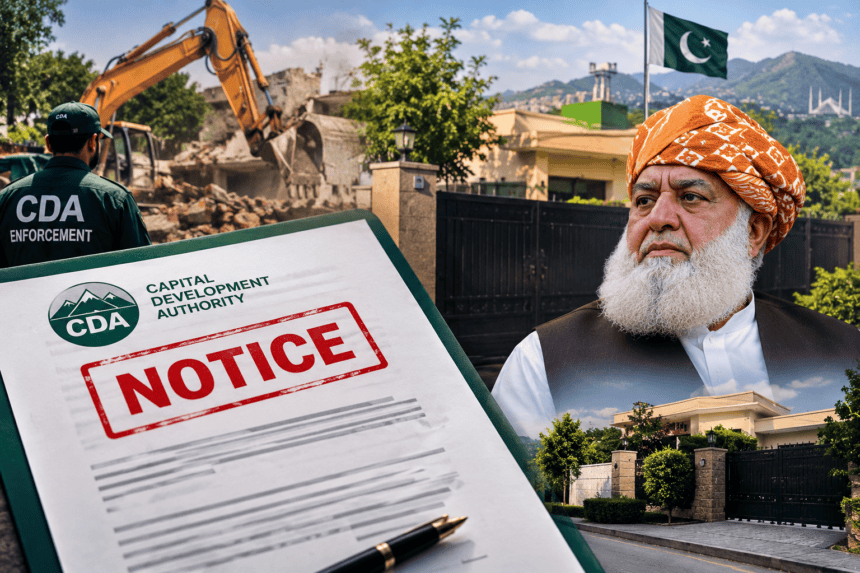
The Capital Development Authority (CDA) has issued a formal notice to Jamiat Ulema-e-Islam-Fazl (JUI-F) chief Fazl-ur-Rehman, alleging that portions of his official residence in Islamabad violate municipal building codes.
The notice, delivered to the Street 25 residence in the G-6/4 sector, demands the immediate removal of structures the authority claims were built on public land. CDA officials allege the perimeter wall and an ancillary gate extend beyond the allotted plot boundaries, effectively blocking a portion of the service lane.
This isn’t the first time the CDA has clashed with high-profile residents over boundary lines, but the timing of this notice has drawn immediate political scrutiny. The JUI-F leadership views the move as a pressure tactic, coming as the party navigates a complex legislative landscape and strained relations with the current administration.
“They are looking for excuses to harass us,” a close aide to the JUI-F chief told reporters on condition of anonymity. “The house has been there for decades. Suddenly, the CDA remembers an encroachment issue?”
The CDA, however, maintains this is part of a broader, city-wide crackdown on illegal construction. The authority has spent the last month surveying government-allotted plots, citing a backlog of complaints regarding blocked access routes in the capital’s older sectors.
For the CDA, the legal path is clear: if the encroached area isn’t vacated within the provided timeframe, the authority reserves the right to initiate a demolition operation. For Fazl-ur-Rehman, the challenge is now both legal and optics-driven. He must either concede to the CDA’s survey or prove that the current structure holds historical authorization—a feat that often proves difficult in the bureaucratic maze of Islamabad’s land records.
The deadline for the response is set for the coming week. Whether the CDA follows through with heavy machinery or settles for a legal standoff remains the central question for the capital’s power corridors.