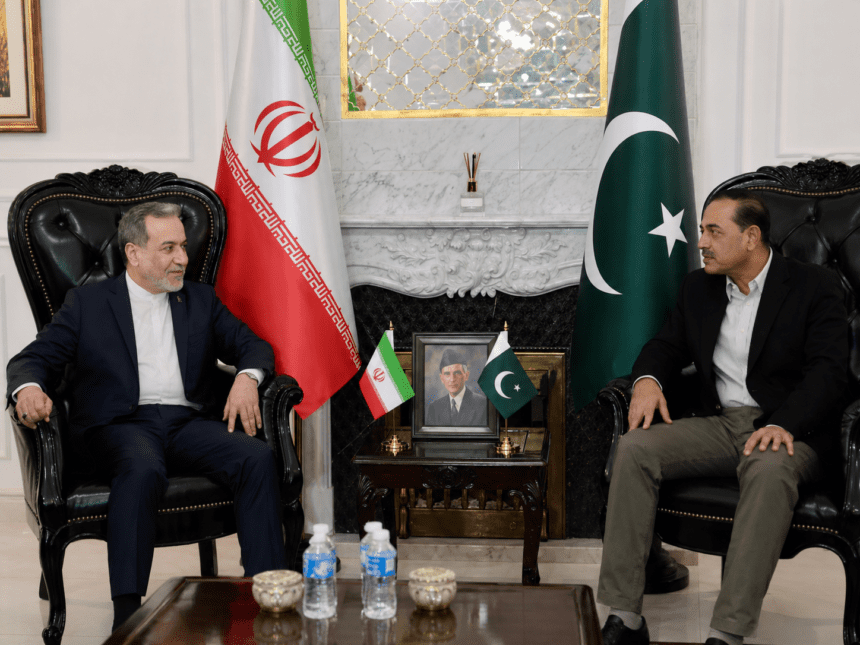
Iranian Foreign Minister Abbas Araghchi met Pakistan’s Chief of Defence Forces, Field Marshal Asim Munir, in Islamabad on Saturday, with the talks focusing on regional security, bilateral ties and the fast-moving diplomatic situation around Iran. Pakistani official material issued ahead of the visit said Araghchi’s meetings in Islamabad would cover bilateral relations as well as developments in the Middle East. Recent local reporting said his discussion with Munir also touched broader regional stability.
The meeting came at a tense moment. Araghchi arrived in Pakistan as Islamabad tried to keep its role alive as a go-between in the wider U.S.-Iran crisis. The Associated Press reported that Pakistan has been attempting to revive ceasefire diplomacy between Washington and Tehran, while Iran said no direct meeting with U.S. officials was planned during this visit and that Pakistani officials would instead pass messages between the sides.
Pakistan’s Foreign Office had announced before the trip that Araghchi would meet Prime Minister Shehbaz Sharif and Deputy Prime Minister and Foreign Minister Ishaq Dar, and that the visit would center on the Middle East situation and Pakistan-Iran bilateral relations. A separate Foreign Office update said Dar welcomed Araghchi at the ministry and that the two sides were expected to discuss trade, the economy, energy and ongoing regional developments.
That gave Munir’s meeting with the Iranian foreign minister extra weight. It followed Munir’s recent three-day visit to Iran, during which Pakistan’s military said he discussed “sustainable regional peace” and stressed dialogue, de-escalation and peaceful resolution of disputes. In practical terms, this latest Islamabad contact looks less like a routine courtesy call and more like part of an ongoing Pakistan-Iran channel on security and crisis management. That last point is an inference from the sequence of official and media reports, rather than a direct statement from either side.
Araghchi’s stop in Islamabad also fed into a bigger diplomatic picture. AP reported that U.S. envoys Steve Witkoff and Jared Kushner were being sent to Pakistan as Washington searched for a way to restart negotiations with Iran, even as fighting and shipping disruption around the Strait of Hormuz kept global nerves on edge. Iran, though, publicly ruled out direct talks during this particular visit.
For Pakistan, the optics were hard to miss. Islamabad has been presenting itself as a state that can still talk to all sides: Tehran, Washington and regional capitals worried about spillover from the crisis. Munir’s role has grown in that effort. AP described him last week as playing a crucial part in Pakistan’s behind-the-scenes contacts with both American and Iranian leaders as the government pushed for de-escalation.
What was not immediately clear from official readouts was whether the Munir-Araghchi meeting produced any concrete new proposal, or whether it was mainly about coordination ahead of the next diplomatic steps. Still, the fact that the Iranian foreign minister’s Islamabad schedule included Pakistan’s top civilian leadership as well as Munir underlined how closely security, diplomacy and regional politics are now overlapping in this file.