DERRY/LONDONDERRY, NORTHERN IRELAND — More than a decade after one of Europe’s largest illegal waste dumps was discovered on the outskirts of Derry/Londonderry in Northern Ireland, authorities say the physical clean-up of the toxic site could potentially begin in 2028 — but politicians, residents and environmental campaigners remain deeply frustrated by the absence of a confirmed timeline, a finalised strategy, or a guaranteed budget.
The Mobuoy Road waste site, which sits just 1.5 kilometres east of Derry/Londonderry and directly beside the River Faughan — a source of drinking water for much of the city — has become one of the most contentious and alarming environmental scandals in Northern Ireland’s recent history. What began as a local waste management concern has grown into a full-scale environmental crisis that touches on criminal negligence, governmental failure, public health, and the long-term safety of a community’s most basic resource: clean water.
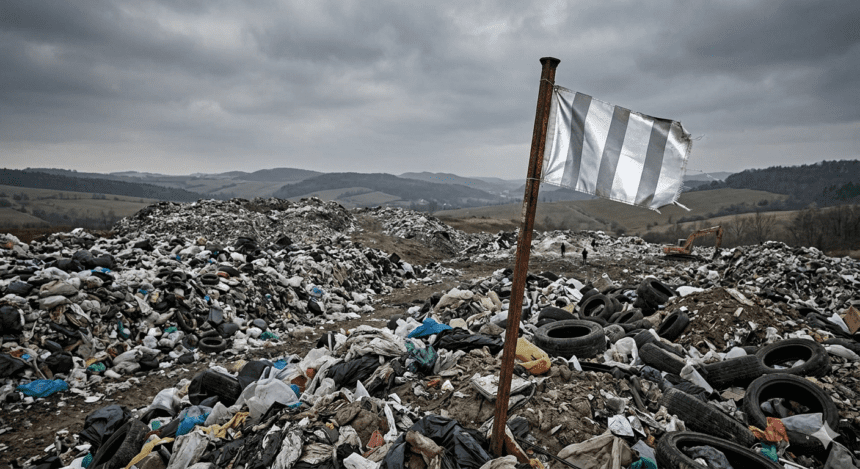
Nestled in Campsie, just outside Londonderry, the Mobuoy dump emerged as a shocking discovery in 2013, branded as one of Europe’s largest illegal landfills. Spanning more than 100 acres, this site holds an estimated 1.6 million tonnes of waste, threatening the River Faughan and the community that depends on it.
The Mobuoy Road waste site consists of two distinct parcels of land — the City Industrial Waste site and the Campsie Sand and Gravel site — located approximately 1.5km east of Derry/Londonderry. The site occupies an area of approximately 46 hectares. The River Faughan forms the western boundary of the Mobuoy Road waste site, and this stretch of the river is designated as an Area of Special Scientific Interest and a Special Area of Conservation that supports an Atlantic Salmon population of international importance.
Up to 1.6 million cubic metres of waste — including domestic, industrial hazardous waste such as tarry waste, construction and demolition debris, and metallic waste, some dating back to the 1960s — is buried at Mobuoy.
This is not just a pile of rubbish. It is a layered, complex toxic mass sitting directly upstream from the point where drinking water is drawn for a large portion of Derry’s population — a fact that has kept local residents in a state of sustained anxiety for over a decade.
Two men were jailed for what a judge described as “environmental crime on an industrial scale.” The rubbish was deposited across two parcels of land used by their firms — the Campsie Sand and Gravel company and the City Industrial Waste firm. The judge said both defendants had “acted deliberately” and been “entirely motivated by financial gain.”
The court was told that the amount of waste illegally disposed of could potentially have generated £30 million for one company, and more than £13 million for the other.
Tens of millions of pounds in criminal profit — made by burying toxic waste beside a river that feeds a city’s taps. And yet the community living with the consequences of that crime has waited over a decade for meaningful remediation to even begin.
Authorities have made clear that cleaning up Mobuoy will be one of the most technically demanding and expensive environmental remediation projects ever undertaken in Northern Ireland.
The final clean-up costs have been projected at between £17 million and £700 million, with the most reliable estimate suggesting a cost of £107 million. Officials noted the £107 million figure was not set in stone, as there are other estimates linked to the draft strategy, described as a point-in-time estimate.
The most expensive method of remediation would be the excavation of all the waste at Mobuoy, provisionally estimated at £700 million. However, this was not considered the best solution. Officials stated that the most environmentally, socially and economically sustainable solution was not to dig all the material out, but rather a combination of solutions was the most sustainable approach in terms of the environment, social aspects and economics.
The plan focuses on removing hazardous waste while leaving inert materials like concrete and bricks in place, covered by soil and vegetation to trap pollutants. Barriers aim to stop leaching into the River Faughan, and ongoing water quality checks are deemed essential to catch any emerging threats.
When a remediation plan is eventually backed by the Executive, engineering works may take the best part of a decade, with monitoring to continue until it shows the risk has gone.
Despite years of reviews, consultations, and meetings, the project has struggled to move beyond the planning stage. One of Europe’s largest illegal dumping sites continues to pose environmental threats with no clear plan for remediation. Politicians who attended a recent meeting with the environment minister expressed frustration over the lack of concrete progress. The gathering, which was expected to provide clarity on next steps for addressing the illegal waste accumulation, instead highlighted the complex challenges facing authorities as they grapple with the massive cleanup operation ahead. The absence of both a timeline and cost estimate for remediation efforts underscores the scale of the environmental challenge posed by the site.
Environment Minister Andrew Muir stated: “I have moved as quickly as possible to complete the public consultation on the draft remediation strategy for the Mobuoy site. The summary report on consultation responses was published on March 12, 2026, and the revised strategy should be with me later this month. Overall, the Northern Ireland Environment Agency’s review and assessment of responses have not indicated any need for fundamental changes to the proposed integrated remediation techniques. However, there are areas in which further clarification and refinement will strengthen the strategy.”
An elected representative said he was “disappointed” by the lack of new information at a recent meeting. “We have no estimated cost, no estimated timeline and there is no guarantee that this work is going to be done,” he said.
Perhaps the most alarming dimension of the Mobuoy crisis is its proximity to Derry’s drinking water supply. The River Faughan, which runs along the western boundary of the site, is the source from which a significant portion of the city’s tap water is drawn.
Northern Ireland Water and the Department of Agriculture, Environment and Rural Affairs both confirmed there have been no breaches in water quality since the scale of the illegal dump came to light. However, experts and residents warn that the longer the waste remains unaddressed, the greater the risk of contamination seeping into the groundwater and ultimately reaching the river. An elected official previously described the situation as a “ticking time bomb,” warning that the longer it is left without major work being done, the more of a threat it poses.
Mobuoy is not an isolated case. Illegal waste dumping is a significant problem across Europe, with one law enforcement agency identifying it as one of the fastest-growing areas of organised crime in the continent. Analysis has identified over 2,000 illegal dumps across Europe, though there are likely many more.
A Europe-wide clean-up would be substantial — research from a private company put the estimated cost, including the UK but not Norway, at between €100 billion and €1 trillion. Despite mounting risks exacerbated by climate change, landfill clean-up falls squarely on landowners or national authorities — in most cases the municipality or local authority, which are usually cash-strapped public bodies.
The Environment Minister has indicated that a finalised remediation strategy is expected to be submitted for approval in the coming weeks, with hopes that physical clean-up work could begin as early as 2028 — though no formal date has been confirmed. Since the dump was discovered, the Northern Ireland Environment Agency has spent more than £4 million managing the risk to public health from the site — money spent simply keeping a dangerous problem contained, not solved.
For the thousands of residents who live near Mobuoy, who drink the water that flows past it, and who have watched more than a decade pass without resolution, the 2028 target — if it holds — cannot come soon enough.
The Mobuoy story is ultimately about three failures occurring simultaneously: the failure of criminal individuals who prioritised profit over public safety; the failure of regulatory bodies that allowed illegal dumping to continue for years under their watch; and the failure of successive governments to act with the urgency that a crisis of this scale demands. As Northern Ireland inches toward a remediation plan, the community of Derry/Londonderry continues to wait — living beside a toxic legacy that should never have been allowed to exist in the first place.