The morning commute in Gulistan-i-Jauhar has devolved into a high-stakes obstacle course. For the thousands of residents navigating the neighborhood’s arterial roads, the journey to work or school is no longer a routine—it’s a grueling test of endurance and vehicle maintenance.
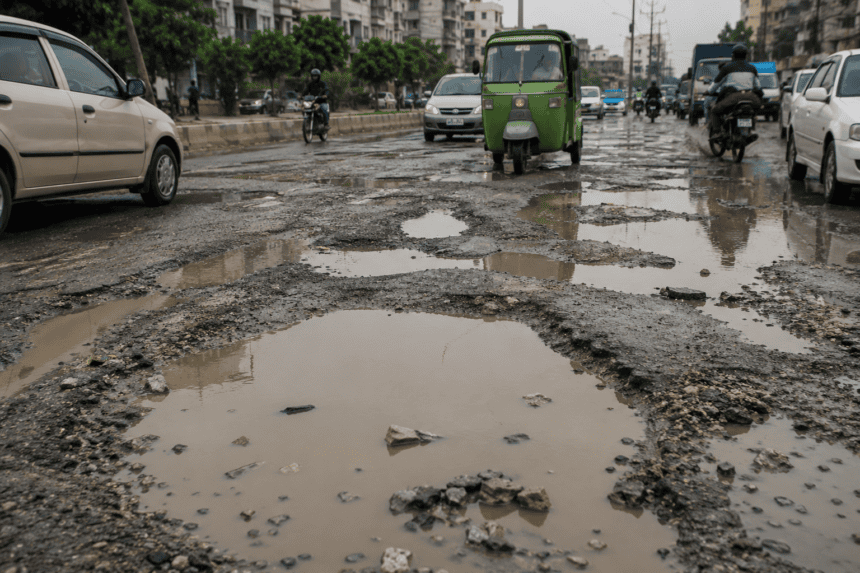
Deep, jagged craters have replaced what were once paved lanes. During peak hours, traffic crawls to a near-standstill as drivers weave erratically to avoid axle-snapping pits, turning narrow streets into bottlenecks that stretch for kilometers.
“My car’s suspension is shot,” said Saleem Ahmed, a daily commuter who has lived in Block 13 for over a decade. “I spend more on repairs than I do on fuel. You either hit a hole and break your car, or you swerve and risk hitting a motorcycle. There is no winning.”
The damage isn’t just cosmetic. Poor drainage systems mean that when it rains—or even when water lines leak—these potholes fill with murky, stagnant water, masking their true depth. Motorcyclists are the most vulnerable, with frequent reports of riders skidding or losing balance as they hit unseen depressions in the road surface.
Local authorities have largely remained silent, despite years of escalating complaints from resident associations. While patch-work repairs are occasionally attempted, they rarely last more than a few weeks. A thin layer of gravel and low-grade bitumen is no match for the heavy flow of heavy-duty water tankers and public buses that traverse these residential arteries daily.
The economic cost is mounting. Local shopkeepers report that the dust kicked up by vehicles hitting these craters is ruining inventory, while ride-hailing services are increasingly refusing to accept pickups within the neighborhood’s interior blocks. Drivers simply don’t want to subject their vehicles to the terrain.
For the people of Gulistan-i-Jauhar, the broken roads are a constant reminder of administrative neglect. Until a permanent solution replaces these temporary, failing fixes, the neighborhood remains a bottleneck where infrastructure failure dictates the rhythm of daily life.