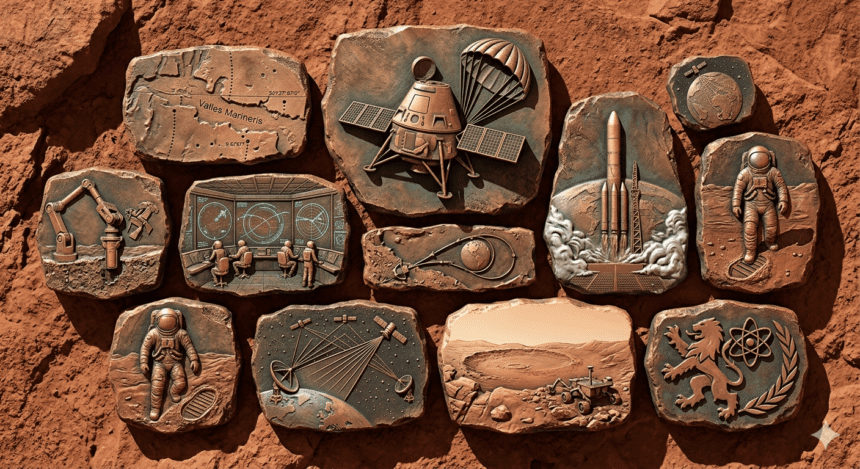
The UK’s first mission to the Martian surface, the Beagle 2 lander, has received a unique posthumous tribute. Thirteen commemorative plaques have been installed across the country to honor the teams that built the craft and the scientific ambition behind its ill-fated 2003 mission.
For over a decade, the fate of the lander remained one of space exploration’s most frustrating mysteries. It vanished upon its scheduled touchdown on Christmas Day 2003, leaving mission control in the dark. It wasn’t until 2015 that high-resolution images from NASA’s Mars Reconnaissance Orbiter finally revealed the craft sitting on the surface, its solar panels only partially deployed.
The plaques, unveiled to coincide with the 20th anniversary of the mission’s arrival, serve as a reminder that failure in deep space doesn’t equate to a lack of achievement. Each marker highlights the specific contributions of the institutions involved, ranging from the Open University to various regional engineering hubs that pushed the boundaries of miniaturized technology.
Professor Colin Pillinger, the mission’s charismatic lead scientist who died a year before the lander was finally located, was the driving force behind the project. His vision was to prove that small, low-cost missions could provide high-impact science. While Beagle 2 didn’t transmit the data he dreamed of, it paved the way for the UK’s subsequent role in major international planetary missions.
“Beagle 2 was a pioneer,” said a spokesperson for the commemoration project. “It proved that you could build a world-class instrument in a garage-style environment on a shoestring budget. That spirit is still embedded in the UK space sector today.”
The plaques are distributed across sites that hosted the original development teams. By marking these locations, the initiative aims to keep the history of British planetary exploration visible, rather than relegated to archives.