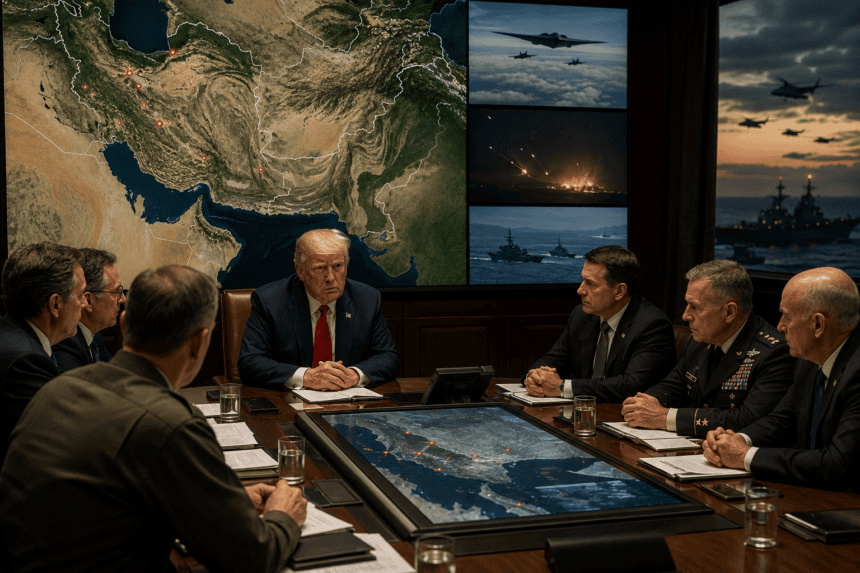
President Donald Trump met with his national security team at the White House today to determine whether to intensify military operations against Iran. The discussions follow a week of escalating regional tensions that have left administration officials divided on the risks of a broader conflict.
Inside the Situation Room, the mood was tense. Two senior officials familiar with the discussions described a split between hawks pushing for a decisive, direct strike on Iranian infrastructure and those cautioning that a wider campaign could trigger a regional war no one is prepared to manage.
Trump, who has long campaigned on a promise of avoiding “endless wars,” finds himself at a crossroads. He is balancing pressure from congressional allies to show strength against the logistical reality that the U.S. military footprint in the Middle East remains vulnerable to retaliatory missile salvos.
“The President is listening to all sides,” one aide said, requesting anonymity to discuss private deliberations. “He wants to hit back hard, but he’s asking what happens the day after.”
The Pentagon has presented a range of options, from targeted cyber-attacks on Iranian defense networks to sustained air strikes against Islamic Revolutionary Guard Corps (IRGC) positions. Neither option guarantees a change in Tehran’s behavior, a reality that has frustrated some of the President’s advisors who argue that past restraint has only emboldened Iranian leadership.
Meanwhile, oil markets reacted sharply to the uncertainty. Prices surged nearly 3% within hours of reports that the cabinet meeting was underway, reflecting investor fears that a full-scale confrontation could disrupt the Strait of Hormuz—the world’s most critical oil chokepoint.
The administration’s dilemma is compounded by the lack of a clear exit strategy. If the U.S. commits to an intensified strike campaign, it must also prepare for the likelihood that Iranian proxies in Iraq, Lebanon, and Yemen will open new fronts.
For now, the White House has released no official statement on the outcome of the meeting. The President’s next move remains as opaque as the intelligence reports driving the debate. Whether he opts for the limited strikes favored by the diplomatic wing or the aggressive posture pushed by his defense advisors will likely be clear within the next 48 hours.
Until then, the region remains on a knife-edge.