
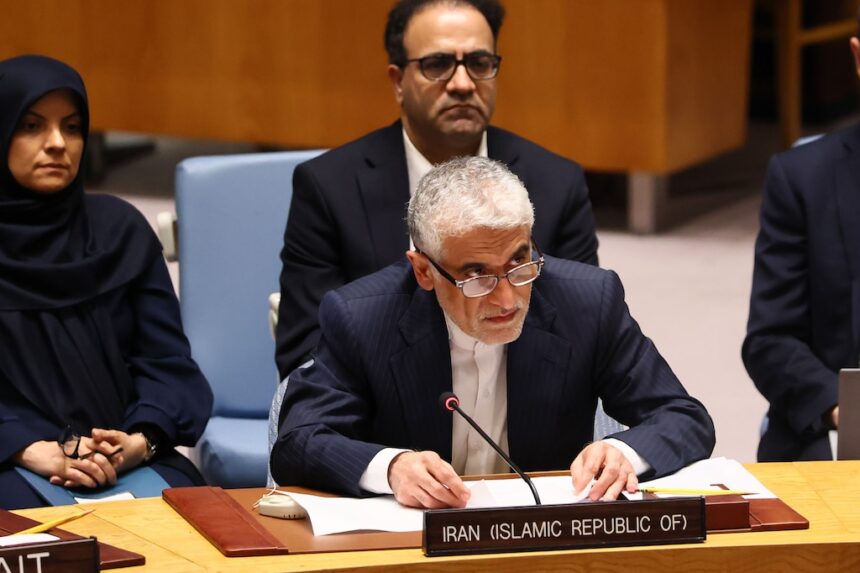
The United Nations Security Council will vote today on whether to stop the automatic return of sanctions against Iran over its nuclear program. The vote comes as European leaders warn that time for a diplomatic solution is running out.
The resolution, introduced by South Korea as the council’s current president, needs at least nine of the 15 members’ support to block the sanctions. Without approval, the penalties outlined in Iran’s 2015 nuclear deal will automatically snap back at the end of the month.
France, Germany, and the United Kingdom triggered the “snapback mechanism” last month, which restores all U.N. sanctions that were lifted under the nuclear accord. These include a conventional arms embargo, bans on ballistic missile development, asset freezes, travel restrictions, and prohibitions on nuclear-related technology. The process cannot be vetoed unless the Security Council itself votes to halt it.
Diplomatic talks between Iran and European nations have intensified in recent weeks but produced little progress. French President Emmanuel Macron told Israel’s Channel 12 on Thursday that sanctions are now “a done deal,” criticizing Iran for not showing serious commitment. EU foreign policy chief Kaja Kallas echoed that warning, saying Tehran must immediately cooperate with the International Atomic Energy Agency (IAEA) and allow unrestricted inspections.
Iranian Foreign Minister Abbas Araghchi rejected the move, calling the reimposition of sanctions “without legal or logical justification.” He highlighted a separate agreement with the IAEA mediated by Egypt granting inspectors access to all nuclear sites and requiring Iran to report on its nuclear material.
IAEA chief Rafael Grossi confirmed the arrangement, noting it ensures clear procedures for inspection notifications and access to all facilities. However, he did not specify when the inspections would begin.
The debate comes against the backdrop of a 12-day war in June, during which Israeli and U.S. strikes targeted Iranian nuclear sites. Those attacks raised doubts about the safety and scale of Iran’s uranium stockpile, which is enriched close to weapons grade levels.
Analysts warn that activating the snapback sanctions could escalate tensions further. Iranian officials have previously threatened to exit the Nuclear Nonproliferation Treaty altogether a step North Korea took in 2003 before developing nuclear weapons.