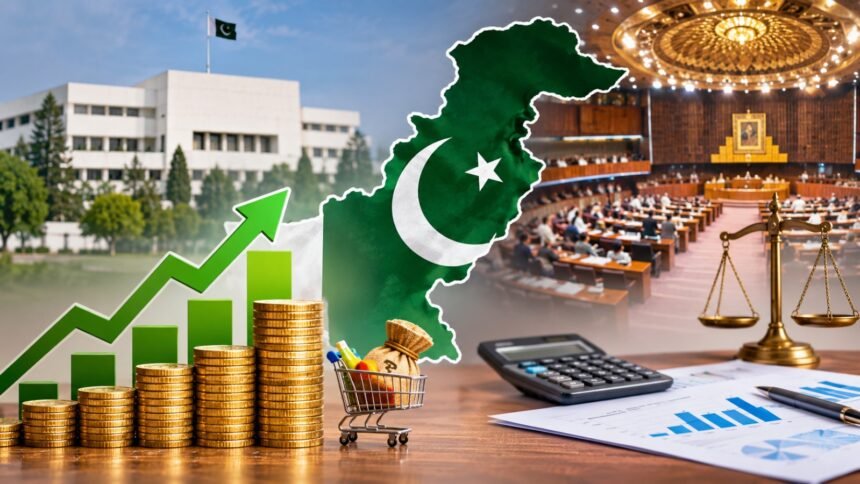
Economic stability in Pakistan is closely linked to political stability, policy consistency and investor confidence, as uncertainty continues to pose challenges to the country’s economic recovery.
Recent economic assessments have highlighted how political uncertainty, changing government policies and institutional challenges can affect business activities, investment decisions and long-term economic growth.
According to a recent study by the Lahore School of Economics, Pakistan’s Economic Policy Uncertainty Index increased by 33.21 per cent in October 2026, reaching 216.42. Higher interest rates, revenue shortfalls and changes in trade policies were among the factors contributing to the increase.
The report also highlighted concerns over investor confidence, with uncertainty surrounding economic and trade policies creating additional pressure on businesses.
Experts believe that political stability is essential for maintaining consistent economic policies and attracting both domestic and foreign investment. Frequent policy changes and political confrontations can make investors cautious about committing funds to long-term projects.
The International Monetary Fund has also emphasised the importance of strong institutions, policy consistency and sustained economic reforms to support Pakistan’s economic growth.
Analysts stress that improving economic conditions requires political consensus, effective governance, tax reforms, energy-sector improvements and a business-friendly environment.
They further argue that sustainable economic growth cannot be achieved through short-term financial measures alone. A stable political environment and consistent economic policies are necessary to strengthen investor confidence, create employment opportunities and improve living standards.
Pakistan’s economic recovery, therefore, depends not only on financial reforms but also on political stability, institutional cooperation and continuity in policymaking.