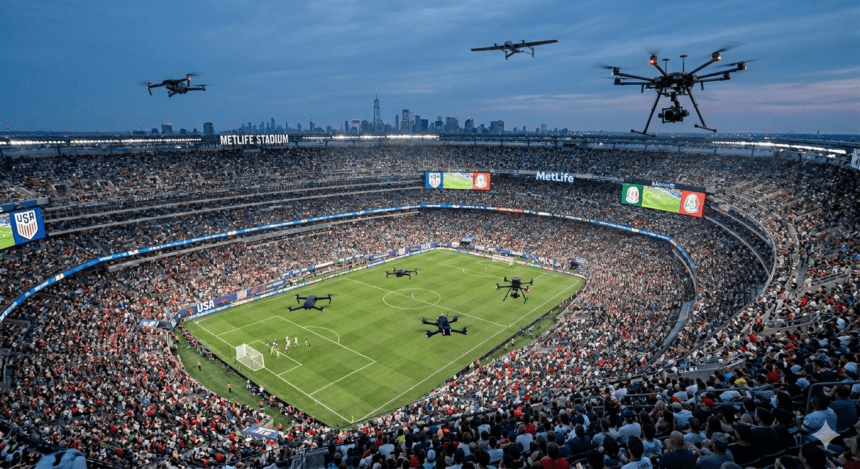
NEW YORK — As the 2026 FIFA World Cup approaches, security officials across North America are quietly overhauling their air defense strategies. The primary concern isn’t just ticket scalpers or crowd control; it’s the proliferation of cheap, off-the-shelf drones capable of disrupting matches or, worse, targeting high-density stadiums.
With 16 host cities spread across the U.S., Canada, and Mexico, the challenge is unprecedented. Stadiums that once focused on perimeter fencing and bag checks are now integrating sophisticated counter-unmanned aircraft systems (C-UAS). These systems must detect, track, and—if necessary—neutralize unauthorized drones without triggering panic in packed arenas.
“The technology is moving faster than the regulations,” said a security consultant familiar with the planning process. “A drone that costs $500 today can carry a payload that creates a nightmare scenario for local law enforcement. It’s no longer about state actors; it’s about the lone operator with a grudge.”
The Federal Aviation Administration (FAA) is expected to implement strict “No Drone Zones” over every host stadium, as they do for the Super Bowl. However, enforcement remains the weak link. Signal jamming technology—the most effective way to drop a drone—is heavily restricted in the U.S. due to FCC regulations, which fear interference with emergency communications and local infrastructure.
Local police departments, often the first responders, are currently training on portable detection gear. This equipment identifies the radio frequency of a drone’s remote controller, pinpointing the operator’s location in real-time. Yet, catching the pilot is only half the battle. If a device is already mid-flight toward a pitch, the window to react is measured in seconds.
The complexity is compounded by the geography of the tournament. Toronto, Los Angeles, and Mexico City present vastly different airspace environments. In Mexico City’s Estadio Azteca, the density of the surrounding urban sprawl makes traditional radar detection nearly impossible. In contrast, the sprawling footprints of U.S. stadiums provide more room for sensor arrays but leave large, open parking lots vulnerable to ground-based interference.
FIFA has historically relied on host nations to shoulder the security burden. For 2026, the governing body is coordinating a tri-national task force to standardize protocols. Despite this, the pressure remains on municipal authorities to bridge the gap between federal intelligence and local tactical reality.
Failure to secure the airspace won’t just risk the safety of players and fans; it would provide a global stage for disruption that no amount of post-event investigation could rectify. As the kickoff date nears, the race is on to ensure that the skies over the world’s biggest sporting event remain under control.