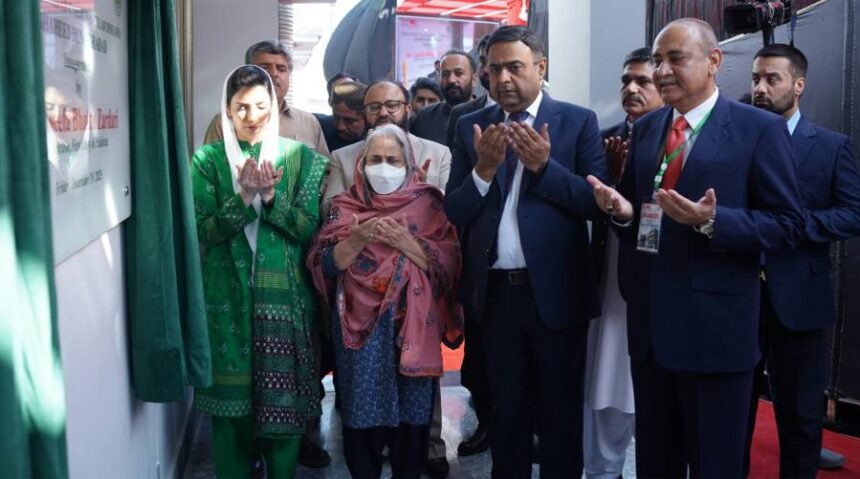
SHAHEED BENAZIRABAD: Pakistan’s public healthcare landscape marked a significant advancement with the inauguration of SICVD Shaheed Benazirabad, a modern cardiac care facility under the Sindh Institute of Cardiovascular Diseases (SICVD) network. The inauguration ceremony was graced by Aseefa Bhutto Zardari, First Lady of Pakistan, as the Chief Guest, underscoring the government’s continued focus on accessible and equitable healthcare.
Expanding access to free, world-class cardiac services
The newly inaugurated hospital is a 55-bedded, purpose-built cardiac facility, designed to deliver 24/7 cardiac emergency services, primary angioplasty, and pediatric cardiac care, all completely free of cost. With additional preparations underway, the center is also expected to introduce stroke intervention services in the near future—further strengthening emergency care in Central Sindh.
Originally established on April 12, 2018, within Peoples Medical University Hospital, SICVD Shaheed Benazirabad has now been relocated to a dedicated hospital building due to space constraints. This transition significantly enhances its capacity, infrastructure, and service delivery for patients across Nawabshah and surrounding districts.
Leadership appreciation and public health commitment
Addressing the occasion, Ms. Aseefa Bhutto Zardari commended SICVD and the Government of Sindh for their sustained efforts in strengthening the public healthcare system. She highlighted that institutions like SICVD have become a lifeline for underprivileged and marginalized communities, offering timely, high-quality cardiac treatment without financial barriers.
The ceremony was also attended by Syed Ghulam Mustafa Shah, along with senior government officials, healthcare professionals, and representatives from across the SICVD Network—reflecting broad institutional and political support for public-sector healthcare expansion.
Government and philanthropic support drive impact
Speaking at the event, Dr. Azra Fazal Pechuho, Minister for Health, Sindh, reaffirmed the provincial government’s commitment to strengthening institutions like SICVD. She described SICVD Shaheed Benazirabad as a landmark addition to Sindh’s healthcare infrastructure, aimed at reducing health disparities and ensuring cardiac care for all—regardless of geography or income.
She also acknowledged the vital role of philanthropy, appreciating the contributions of Haji Ghulam Rasool Memorial Hospital, Chaudhry Muhammad Zafar Arain, and Mr. Azeem Mughal, whose support was instrumental in making the facility a reality.
Vision for the future of cardiac and emergency care
During the ceremony, Prof. Jawaid Akbar Sial, Executive Director SICVD, presented an overview of the rapidly expanding SICVD Network. He highlighted performance indicators, patient impact, and upcoming initiatives, including further hospital expansions, enhanced emergency response systems, and planned stroke intervention programs.
Addressing the gathering, Prof. Sial emphasized that SICVD Shaheed Benazirabad represents a promise to the people of Sindh—to deliver advanced, timely, and completely free cardiac care at their doorstep. From emergency interventions and angioplasty to pediatric cardiology and future stroke services, the facility is expected to serve thousands of patients annually.
Strengthening the world’s largest free cardiac network
Today, SICVD stands as the world’s largest free cardiac healthcare network, comprising 10 full-fledged cardiac hospitals and an extensive Chest Pain Unit (CPU) network across Sindh. The addition of SICVD Shaheed Benazirabad further reinforces its mission to bring advanced cardiac and emergency care closer to underserved and remote communities, setting a powerful example for public healthcare delivery in Pakistan.