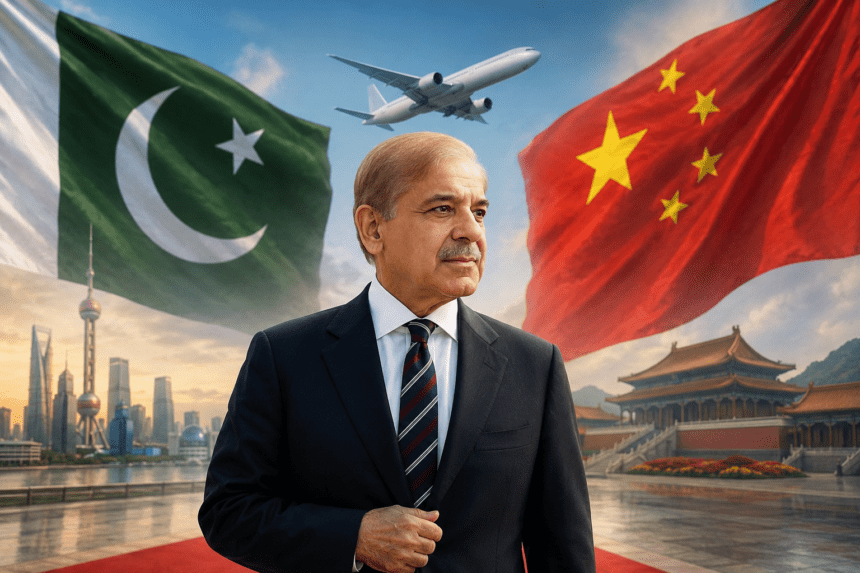
Islamabad: Prime Minister Shehbaz Sharif will pay an official visit to China from May 23 to May 26, as Islamabad and Beijing look to deepen political, economic and strategic cooperation during another high-level diplomatic engagement.
China’s Foreign Ministry confirmed the visit, saying Shehbaz Sharif would travel to China at the invitation of Premier Li Qiang. The announcement also said the visit would be official in nature, though detailed engagements were not listed in the brief statement.
The trip had earlier been announced by Deputy Prime Minister and Foreign Minister Ishaq Dar, who said the prime minister would visit China from May 23 to 26 and attend a business-to-business forum on May 24. The forum is expected to focus on trade, investment and private-sector linkages between the two countries.
The visit comes at a time when Pakistan is trying to attract foreign investment, strengthen digital cooperation and push forward the next phase of economic engagement with China. Officials have repeatedly described Beijing as Islamabad’s most important strategic partner, and this trip is likely to reinforce that message.
According to reports, the agenda is expected to include discussions on bilateral ties, economic cooperation, regional developments and issues of mutual concern. China’s Foreign Ministry spokesperson said leaders of the two countries would exchange views on Pakistan-China relations and shared priorities during the visit.
The visit also follows President Asif Ali Zardari’s recent trip to China, during which both sides signed several memoranda of understanding aimed at expanding cooperation in key economic sectors. That gives the prime minister’s visit a follow-up role, especially on projects that require political direction and investor confidence.
For Pakistan, the economic side of the visit may be the most closely watched. Islamabad wants more Chinese investment in industry, technology, infrastructure and export-oriented sectors. The planned B2B forum could provide a platform for Pakistani and Chinese companies to explore partnerships beyond traditional government-to-government projects.
The China-Pakistan Economic Corridor is also expected to remain part of the broader conversation. While CPEC has already delivered major infrastructure and energy projects, Pakistan now wants to shift the focus toward industrial cooperation, agriculture, technology and special economic zones.
The diplomatic timing matters too. Regional tensions, global economic uncertainty and shifting alliances have made Pakistan’s relationship with China even more central to its foreign policy. For Beijing, Pakistan remains a long-standing partner in South Asia and an important part of its regional connectivity plans.
Officials in Islamabad are likely to frame the visit as another step in strengthening the “all-weather strategic cooperative partnership” between the two countries. But beyond the familiar diplomatic language, the real test will be whether the visit produces concrete movement on investment, trade access and project implementation.
The prime minister is scheduled to leave for China on May 23 and return after completing the four-day visit on May 26.