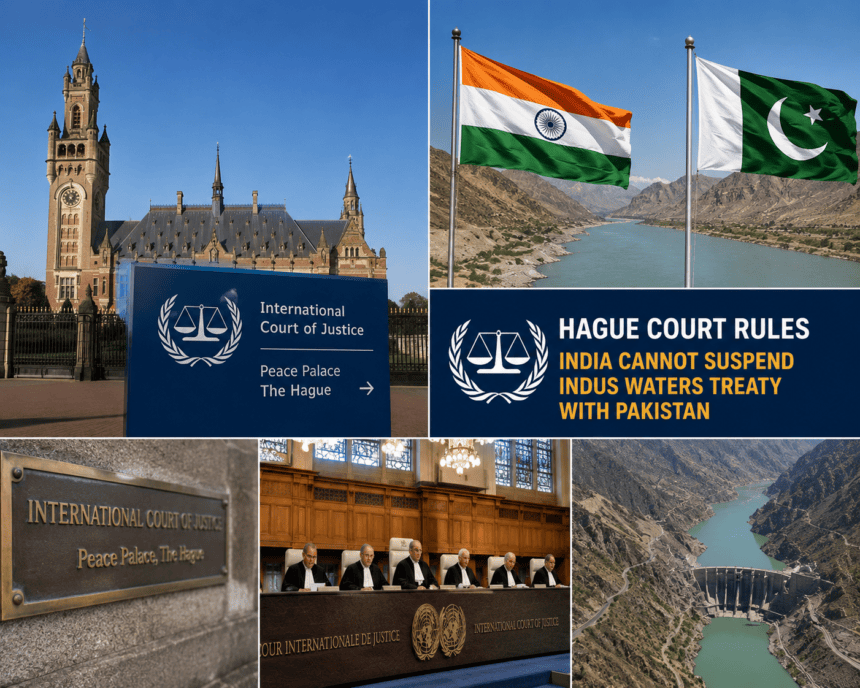
The Permanent Court of Arbitration in The Hague has delivered a definitive ruling: India lacks the legal authority to unilaterally suspend or alter the 64-year-old Indus Waters Treaty. The decision settles a long-standing dispute over the interpretation of the treaty’s dispute-resolution mechanisms, effectively barring New Delhi from bypassing the established arbitration process.
The ruling centers on the Kishanganga and Ratle hydroelectric projects. India had argued that the treaty’s provisions for a “Neutral Expert” were the only path forward. Pakistan, however, pushed for the Court of Arbitration to address technical design issues that Islamabad claims violate the treaty’s water-flow requirements.
By affirming the primacy of the Court of Arbitration, the judges have effectively rejected India’s attempt to characterize the dispute as a matter only for a Neutral Expert. This is a procedural victory for Pakistan, which has long maintained that India’s dam construction on western rivers threatens its own agricultural stability.
For India, the ruling is a diplomatic setback. New Delhi has consistently signaled frustration with the pace of the arbitration process, often accusing Pakistan of using the treaty to stall infrastructure development. Officials in New Delhi have previously hinted that the treaty itself might need a fundamental review, a suggestion that now faces a significant legal wall.
The Indus Waters Treaty, brokered by the World Bank in 1960, has survived three wars and decades of heightened hostility. It remains one of the world’s most durable water-sharing agreements, largely because it provides a rigid framework for technical cooperation.
Legal experts suggest that the Hague’s decision reinforces the treaty’s “sanctity.” It forces both nations to return to the table under the existing rules, rather than allowing either side to leverage geopolitical pressure to override the treaty’s technical stipulations.
The ruling does not resolve the water crisis itself, nor does it address the underlying design flaws that keep tensions high in the Kashmir region. Instead, it locks both nations into a legal process they have spent years trying to circumvent.
With this decision, the court has signaled that the treaty is not a document to be renegotiated at the whim of one party, but a binding international commitment that requires consensus to change. Whether either government has the appetite for that level of cooperation remains the real question.