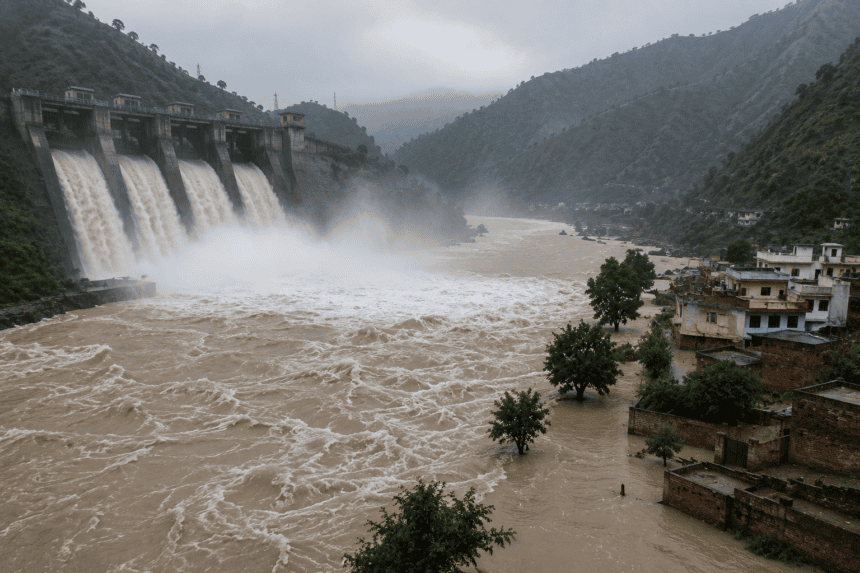
India’s release of water into the Chenab River has triggered emergency alerts across Pakistan’s Punjab province, as authorities scramble to mitigate potential flooding in low-lying districts.
The discharge, which began late Tuesday, follows heavy monsoon rains in the upper catchment areas of Indian-administered Kashmir. Pakistan’s Flood Forecasting Division (FFD) warned that the sudden surge could push water levels in the Chenab to “high” or “very high” flood levels at the Head Marala and Khanki barrages within 24 to 48 hours.
Local administrations in Sialkot, Gujranwala, and Hafizabad have already moved to clear riverbanks. District authorities are using loudspeakers in riverside villages, urging residents to relocate to higher ground before the water arrives.
“We are tracking the inflow every hour,” said an official with the Provincial Disaster Management Authority (PDMA). “The primary concern isn’t just the current volume, but the speed at which it’s moving toward populated areas.”
The Indus Waters Treaty requires India to share hydrological data during the flood season, a mechanism intended to provide Pakistan sufficient lead time for evacuations. While New Delhi has communicated the release, the rapid nature of the surge leaves little margin for error.
For the residents of these riverine communities, this is a recurring nightmare. Many lost their homes and livestock during the catastrophic floods of 2014, when the Chenab breached its banks. The current infrastructure at Head Marala is being pushed to its capacity, and engineers are operating spillways at maximum output to prevent structural damage.
While the FFD maintains that the situation is currently under control, the unpredictability of monsoon patterns remains a major variable. Heavy rainfall is expected to persist in the region through the weekend, potentially compounding the inflow from the Indian side.
As the water moves downstream, the focus shifts to the barrages below Khanki, where authorities are reinforcing embankments with sandbags and heavy machinery. The next 36 hours will determine whether the river stays within its course or spills into the fertile plains of Punjab.