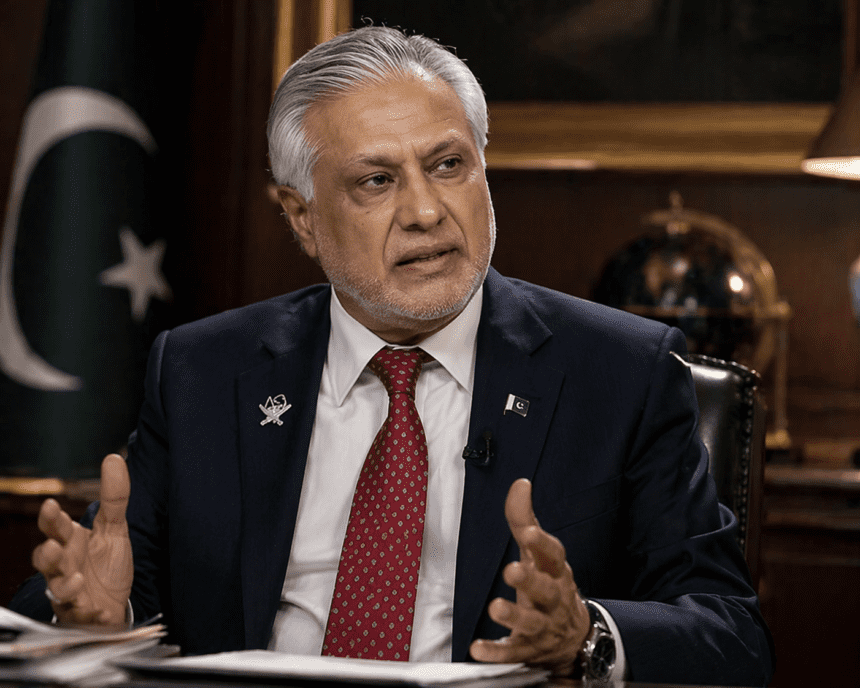
Pakistan’s Deputy Prime Minister and Foreign Minister Ishaq Dar used the Antalya Diplomacy Forum on April 17, 2026 to press for stronger regional trade, arguing that South Asia is still falling far short of its economic potential because trust, connectivity and political will remain weak across the region. He made the remarks during a forum discussion focused on “Trust-Based Trade: The Future of Economic Integration and Stability in South Asia,” held as part of the three-day Antalya gathering in Türkiye.
Dar’s main point was blunt: South Asia is underperforming economically despite its size. According to Anadolu’s report from the session, he said intra-regional trade in South Asia stands at only about 5%, even though the region’s economy is worth nearly $4 trillion. That’s the kind of gap officials talk about all the time, but Dar tied it directly to a larger political failure, saying the region has not built the trust needed for real economic integration.
He put that argument in especially stark terms when speaking about connectivity. “Without trust, there can be no connectivity, and without connectivity, issues cannot be resolved,” Dar said at the forum, calling for what he described as collective and sincere efforts to unlock growth across South Asia. He also said terrorism must be eliminated “from the root cause,” arguing that insecurity prevents countries from prospering and moving forward.
A big part of his message was also about what isn’t working. Dar said the South Asian Association for Regional Cooperation, or SAARC, would have produced a very different trade picture had it been functioning “in true spirit.” With SAARC still effectively stalled, he said Pakistan is looking at trilateral and alternative arrangements, including frameworks involving China and Bangladesh and China and Afghanistan, instead of waiting indefinitely for the broader regional machinery to come back to life.
That gave the speech a more pragmatic edge than a standard diplomatic appeal. Dar did not present a dramatic new trade pact in Antalya. What he did suggest was that Pakistan is increasingly prepared to work through smaller, flexible groupings if the traditional regional platform remains blocked. He also pointed a finger at India, calling it a “stumbling block” when asked about SAARC’s inability to move ahead on exchanges and cooperation, though he added that he was “not here for the blame game.”
The forum appearance came alongside a busy set of bilateral contacts for Dar in Antalya. On the sidelines, he met Bangladesh’s Foreign Minister Khalilur Rahman, in what Anadolu described as their first in-person meeting since the formation of Bangladesh’s new government in February. Pakistan’s Foreign Ministry said the two discussed stronger bilateral ties and wider regional developments. That matters because Dar’s trade message was not delivered in isolation; it came as Pakistan tries to show it is still relevant in regional diplomacy, even as South Asia’s formal institutions remain fractured.
The broader Antalya Diplomacy Forum itself runs from April 17 to 19, 2026, under the theme “Mapping Tomorrow, Managing Uncertainties.” In that setting, Dar’s remarks landed as both an economic pitch and a political diagnosis: South Asia has the market, the population and the geography to trade far more with itself, but it still lacks the minimum trust needed to turn that potential into something real. For Pakistan, the message was pretty clear. Regional trade is still the goal. But if the old road is blocked, Islamabad is ready to look for another one.