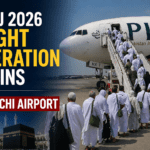
Pakistan’s Hajj 2026 air operation formally began early on Friday, April 18, with one of the first departure points being Karachi airport, as thousands of pilgrims started their journey to Saudi Arabia under the government scheme. The national pre-Hajj flight operation is scheduled to continue until May 21, spanning 34 days, and is set to transport around 119,000 pilgrims through 468 flights. Official schedules issued by the Ministry of Religious Affairs show that the opening day included departures from Karachi, Lahore, Sialkot, and Multan.
For Karachi, the launch carried both logistical and emotional weight. Hajj flights leave every year, of course, but the first departure always feels different. Families arrive long before check-in, prayers begin in corners of the terminal, and airport halls take on a more solemn mood than usual. Reporting around the start of this year’s operation said the first Karachi flight was scheduled around 3:00 a.m., with immigration and boarding formalities already underway as pilgrims gathered at the airport.
This year’s operation is part of a wider government Hajj plan that officials say has been built around tighter coordination, advance training and digital tracking for pilgrims. The Ministry of Religious Affairs has published the full flight schedule online and has also been pushing the Pak Hajj app as a central tool for travelers to check flight details, accommodation information and group assignments. Officials had also completed pre-Hajj training sessions in phases before the launch of the airlift.
The opening day is expected to bring the first Pakistani pilgrims into Madinah, with earlier official reporting saying 660 pilgrims would arrive through the first three flights. That figure gives some sense of the scale at the very start, though the full operation will build rapidly over the coming days as flights expand from additional cities. According to previously announced schedules, later departures are planned from a wider network that includes Islamabad, Quetta, Faisalabad and Sukkur as the operation gathers pace.
The broader Hajj framework for 2026 is also larger than the government scheme alone. Pakistan’s approved Hajj quota is 179,210, split between government and private arrangements, although the current flight schedule widely circulated for the opening phase relates to the government-sponsored pilgrims. Officials have said the state package covers roughly 118,000 to 120,000 people, depending on how the operational total is counted in reporting and official briefings.