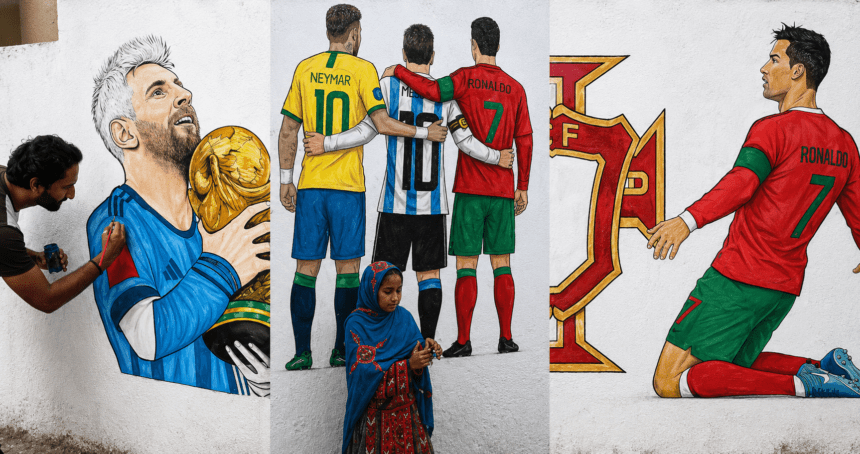
Karachi’s narrow alleys and makeshift concrete pitches are buzzing. With the 2026 FIFA World Cup approaching, the city’s obsession with football is spilling out of the stadiums and onto the streets, turning neglected corners into makeshift arenas.
For many in neighborhoods like Lyari—often called “Little Brazil”—the tournament isn’t just a distant spectacle on a television screen. It’s a catalyst. Local youth are organizing street leagues, painting murals of icons like Lionel Messi and Kylian Mbappé on crumbling walls, and reclaiming public spaces that were once dead zones.
The surge in local activity highlights a stark reality: Karachi has a massive appetite for the sport, yet it lacks the professional infrastructure to support it. While the world prepares for the mega-event in North America, Karachi’s budding players are still navigating broken ground, literally.
“We don’t have turf, but we have heart,” says 19-year-old amateur player Bilal Ahmed, who organizes matches in his block. “When we watch the World Cup, we don’t just watch for the result. We watch to learn the moves we’ll try in the street the next morning.”
The grassroots movement is largely self-funded. Residents pool small amounts of cash to buy proper balls or to paint lines on dusty patches of land. These aren’t just games; they are neighborhood social anchors. In a city frequently fractured by economic instability and crime, these matches offer a rare, neutral ground where the only thing that matters is the next goal.
Despite the enthusiasm, local coaches remain frustrated by the lack of institutional investment. Scouting remains informal at best. While local talent is abundant, the bridge between a street-side game in Karachi and a professional contract remains nearly impossible to cross.
For now, the city’s walls will keep wearing the colors of global football, and the evening air will keep ringing with the sound of plastic balls hitting concrete. The World Cup 2026 may be thousands of miles away, but in Karachi, the game has already begun.