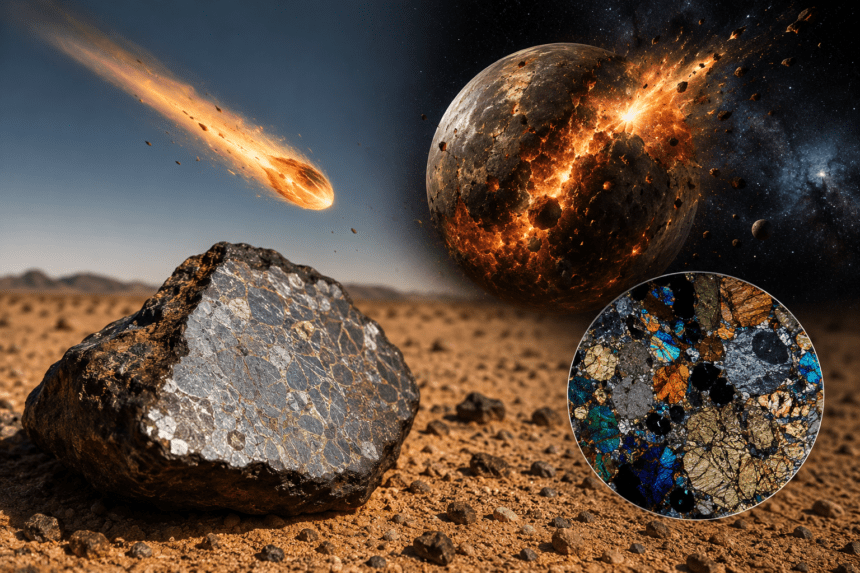
A rare meteorite discovered in the Sahara Desert has provided compelling evidence that it may have originated from a long-destroyed early planet in the solar system.
Scientists analyzing the rock say its chemical composition is unlike most known meteorites, suggesting it came from a planetary body that no longer exists. The findings support the theory that, in the early solar system, several protoplanets formed and later collided, breaking apart into fragments that now travel through space as meteorites.
Researchers examined mineral structures within the sample and found signs of extreme heating and differentiation—processes typically associated with large planetary bodies rather than small asteroids. This strengthens the idea that the meteorite could be a fragment of a “lost planet” destroyed billions of years ago during the formation of the solar system.
The discovery is significant because it helps scientists better understand how planets formed and evolved in the early stages of the solar system. It also provides clues about violent collisions that shaped Earth and its neighboring planets.
Experts believe further analysis of similar meteorites could reveal more about these ancient planetary bodies and the chaotic environment in which the solar system developed.