PESHAWAR — The Khyber Pakhtunkhwa government has launched a province-wide school enrolment campaign for the 2026–27 academic year, setting an ambitious target of bringing 1,328,620 children into the education system, including 684,363 boys and 644,259 girls. Officials say the drive is meant not just to boost fresh admissions, but to pull hundreds of thousands of out-of-school children back into classrooms and slow the province’s stubborn dropout rate.
According to official details released at the launch, the campaign aims to mainstream more than 600,000 children who are currently out of school. The provincial government has also tied the effort to specific retention goals, saying it wants to reduce the primary-level dropout rate from 7% to 5% and the secondary-level dropout rate from 8% to 6%.
The campaign was inaugurated in Peshawar by Elementary and Secondary Education Minister Arshad Ayub Khan alongside Chief Secretary Shahab Ali Shah, with district administrations and education officials directed to treat enrolment as a province-wide priority. The official framing is pretty clear: this is being sold as both an education drive and a governance test, especially in areas where poverty, distance, insecurity and early dropouts keep children — particularly girls — out of school.
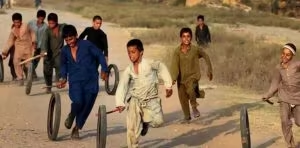
And the scale of the problem is huge. A provincial education support platform says more than 4.9 million children in KP are out of school, citing BISP 2021–22 and PIE 2022–23 data, with 82% of them having already crossed the age limit for regular admission into the formal system. That number helps explain why officials are now talking about multiple routes back into learning, not just standard school admissions.
This latest campaign also builds on earlier efforts. In August 2025, the KP government launched the ILMpact programme, developed with support from the UK and implemented by the British Council, with a target of enrolling 80,000 out-of-school children across eight districts. That earlier initiative focused especially on girls and other vulnerable children, and it now forms part of the wider backdrop to the province’s much bigger 2026 push.
For the government, the politics of this matter almost as much as the policy. Education officials have been under pressure for months to show that repeated promises on access are turning into measurable results. A campaign target above 1.3 million sounds impressive on paper. The harder part, honestly, will be keeping children in school once they are enrolled — especially in districts where families face transport costs, child labour pressures, missing facilities, or a shortage of nearby schools for girls.
That’s really where this story sits. Enrolling children is the first hurdle. Retaining them is the bigger one. If the campaign delivers even part of what officials are claiming, it could mark one of KP’s most significant education interventions in years. But if the province cannot address the reasons children leave school in the first place, the numbers announced this spring may end up looking more like a target sheet than a turning point.