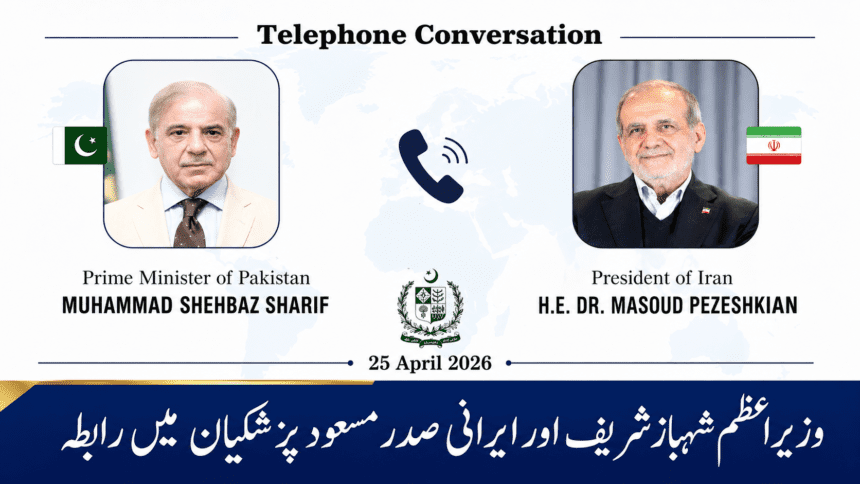
ISLAMABAD — Prime Minister Shehbaz Sharif and Iranian President Masoud Pezeshkian held a telephone conversation on focusing on regional peace, security and the wider diplomatic situation around Iran and the Gulf. Pakistan’s official readout said Sharif reaffirmed that Islamabad would remain committed to “honest and sincere efforts” to advance peace and stability in the region.
According to Radio Pakistan, Sharif also briefed the Iranian president on his recent contacts with the leadership of Saudi Arabia, Qatar and Türkiye, presenting Pakistan’s outreach as part of a broader effort to ease tensions through diplomacy rather than escalation. The message from Islamabad was fairly direct: Pakistan wants to be seen as an active, credible player in regional de-escalation at a moment when the wider neighbourhood remains deeply unsettled.
The Iranian side framed the call in slightly broader terms. Iran’s presidency said Pezeshkian and Sharif discussed the latest regional developments, the Iran-U.S. negotiations in Islamabad, and issues linked to the ceasefire, showing that the conversation went beyond routine bilateral diplomacy and into the live questions shaping the regional security environment.
Independent Pakistani reporting added another detail that gives the exchange more weight: the call reportedly lasted about 45 minutes, suggesting a substantive discussion rather than a brief ceremonial contact. That report also said both leaders underlined the need to continue working together on efforts aimed at regional calm.
This was not the first such contact between the two leaders in recent weeks. Radio Pakistan reported earlier calls on March 23 and March 28, 2026, in which Sharif likewise told Pezeshkian that Pakistan would continue to play a constructive role in promoting peace and stability. That pattern matters. It suggests the latest conversation was part of an ongoing diplomatic channel between Islamabad and Tehran, not an isolated response to one day’s events.
There is also a bilateral layer beneath the regional messaging. Pakistan and Iran have kept high-level engagement active over the past year, including Pezeshkian’s official visit to Pakistan in 2025 and subsequent meetings on the sidelines of multilateral summits. So while the headline is about peace and security, the subtext is about maintaining a steady Pakistan-Iran relationship during a tense and shifting regional moment.
For Islamabad, the diplomatic balancing act is obvious. Pakistan is trying to preserve working ties with Tehran while also engaging key Gulf capitals and positioning itself as a voice for dialogue. For Tehran, keeping Pakistan involved in conversations around negotiations and ceasefire issues offers another regional channel at a time when trust remains thin and the stakes are high. Based on the official statements available so far, both sides want to project continuity, coordination and restraint — even if the region around them remains anything but settled.