LONDON, April 22 — Britain opened two days of military talks in London on Wednesday as officials from more than 30 countries gathered to work on a French- and British-led plan for the Strait of Hormuz, a waterway whose disruption has rattled energy markets and global shipping. The meetings, hosted at the UK’s Permanent Joint Headquarters in Northwood, are meant to turn last week’s diplomatic push into an operational plan for reopening the strait once a sustainable ceasefire is in place.
The proposal, according to the British government, is for an “independent and strictly defensive” multinational mission focused on protecting merchant vessels, reassuring commercial operators and carrying out mine-clearance work when conditions allow. London says the effort is being shaped jointly with Paris and widened to include as many partner countries as possible, with the conference expected to cover military capabilities, command arrangements and how forces could deploy to the region.
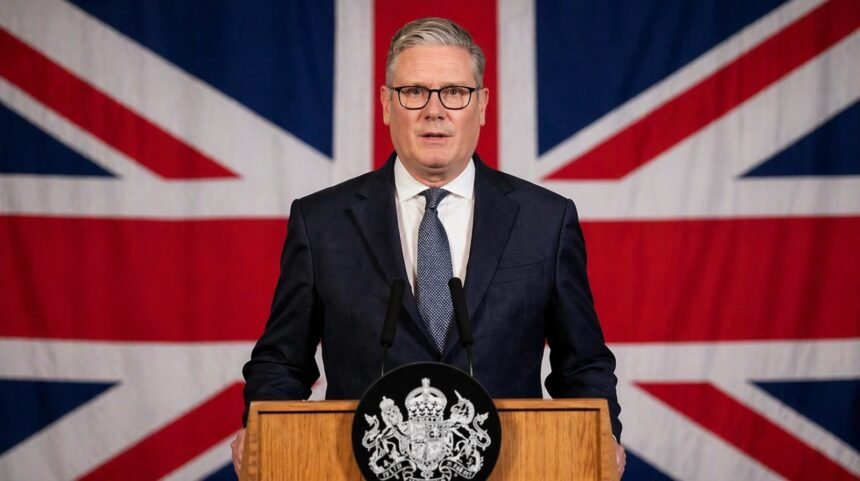
Defence Secretary John Healey framed the gathering as the point where diplomacy meets military planning. In remarks released by the Ministry of Defence, he said the task over the two days was to convert international backing into a joint plan that can safeguard freedom of navigation and support a lasting ceasefire. The wording matters: British officials are trying to signal that the mission is not being presented as a war-fighting coalition, but as a narrowly defensive operation tied to the reopening of a vital trade artery.
The London conference builds directly on the April 17 international summit convened by Prime Minister Keir Starmer and President Emmanuel Macron, where 51 countries backed freedom of navigation and called for the “unconditional, unrestricted, and immediate” reopening of the strait. That joint statement also made clear that France and the UK intended to establish a mission under international law and in consultation with relevant states, while seeking contributions that could range from military assets to logistics, financing and political support.
The urgency is easy to see. The UK government says roughly a fifth of the world’s oil passes through the Strait of Hormuz, and officials argue that the effective closure of the route has already driven up energy prices, strained supply chains and added costs for households and businesses well beyond the Gulf. That is why this story is bigger than a naval planning meeting in north London; for Europe, Asia and import-dependent economies everywhere, Hormuz is less a regional chokepoint than a global pressure valve.
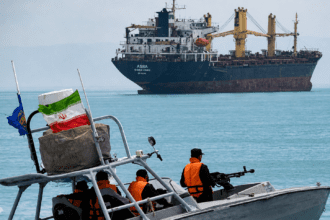
The talks are also opening against a still-dangerous security backdrop. On Wednesday, the Associated Press reported that Iran’s Revolutionary Guard opened fire on a container ship in the strait, damaging the vessel. Britain’s UK Maritime Trade Operations center said the attack happened around 7:55 a.m., that no warning was given before the shooting, and that there were no injuries or environmental damage. The episode underlined, in very blunt fashion, why governments talking about reopening Hormuz are also talking about escorts, reassurance and mine clearance in the same breath.
For now, British officials are careful not to promise immediate deployment. Their public line is that any mission would move only when conditions permit and after a sustainable ceasefire agreement is in place. Still, the fact that planners from over 30 nations are already in the room suggests London and Paris want the coalition structure ready before the politics fully catch up. In other words, the diplomacy is still unsettled, but the military homework has begun.
At the center of all this is a familiar calculation: if the strait cannot be kept open, the economic fallout travels fast and far. So these London talks are about ships, yes, but they are also about oil, insurance, freight, inflation and nerves in global markets. Whether the mission ever sails in full will depend on the ceasefire holding. But by hosting the meeting now, Britain and France are trying to show that they do not want to wait for the next crisis at sea before deciding what the response should look like.